Special for Africa ExPress
Monica Mistretta 9 March 2020
It’s 8:00 pm on March 8, it’s Women’s Day. Rimini has a spooky atmosphere. The city is armored: bars, restaurants, clubs have shutters down, the signage is off, streets are deserted. The few people who had the courage to leave the house are appalled: less than 24 hours before the decree of the Government turned the Romagna party city into a red zone from which you cannot get in and less so out. There is disbelief, uncertainty with only two months to go until the holiday season starts.
200 people are infected in the city, but everyone knows that the figure is set to rise. As the map of infections from Covid 19 broadens in northern Italy, people wonder how and what to defend themselves against invaded with news that raise panic and confusion. Why Rimini?
In the last days, few have paid attention to the incoming flights noticeboard of the city’s small airport, Federico Fellini. But that’s where a lot of questions might be answered. The noticeboards say a lot.
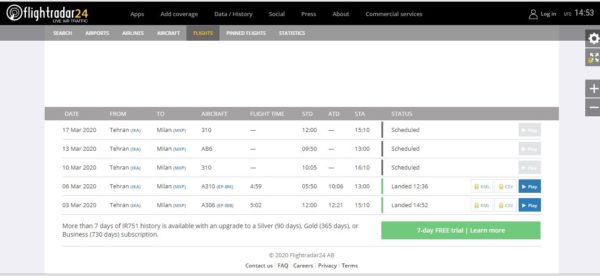
It’s March 3rd, we’re in the middle of a Coronavirus emergency. Rimini is not yet red zone, but contagion spreads, numbers are going up. An A306 aircraft of the Iran Air Airline coming from Imam Khomeini International Airport in Tehran lands at Federico Fellini Airport in the afternoon after making a stopover in Milan Malpensa. Even in the capital of Lombardy, contagion spread is wildly galloping.
On the Flight Radar 24 website, the flight from Iran to the two Italian airports has a name: EP-IBB.
We track it.
At 6.40 pm, the Iran Air plane takes off in the direction of Tehran. Three days later, on March 6th, same thing: the arrival of the plane from Tehran to Milan at 12.36 pm then again stopover in Rimini and return to Iran in the late afternoon.
In Iran the Coronavirus is rampant, it is almost impossible to precisely establish the infection’s levels. Few people trust the figures provided by the Tehran government, which has been trying to minimise the scale of the epidemic since the early days of the emergency. Even so, with more than 9,000 official infections the country is the third outbreak worldwide (after China and Italy).
And yet, while direct flights from the Asian country to Italy were promptly cancelled in the early days of the Coronavirus emergency, for some obscure reason no one thought about stopping those from the Middle Eastern country.
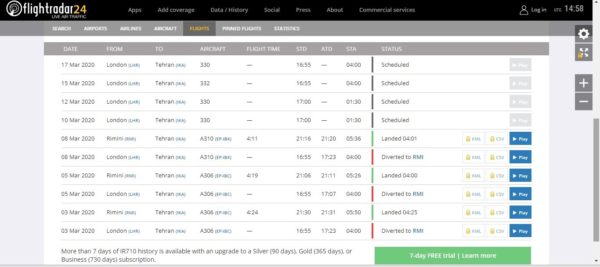
Flight Radar 24 tracks are available for anyone who wants to follow them: we discover that the stopover at the small Federico Fellini airport before the trip to Tehran is a leg that is frequently repeated. The flight route to Malpensa (and Rimini) also works at London’s Heathrow Airport: on the afternoon of March 3rd, adding to the dangerous leg Tehran, Milan, Rimini, an Iran Air plane from London makes a stopover in the City of Romagna and departs in the late evening in the direction of Imam Khomeini airport. On the afternoon of March 8th Rimini is now officially included in the red containment zone of Covid19 but the flight pattern is again repeated with no obstacles of sorts.
What really is shocking is that on March 8th, European countries belatedly decided to block all flights to and from Iran. The news has gone quiet: no big headlines, contrary to what happened for flights with China. The Iranian news agency Irna told us this with a laconic thread: “In reference to the restrictions on Iran Air flights put in place by Europe, for unknown reasons all flights of the airline to Europe have been suspended until further notice.”
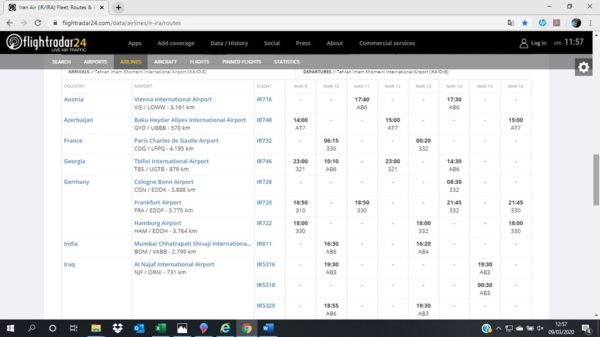
Several Middle Eastern countries such as Turkey blocked flights with Iran as early as February 24. Since then nothing has happened in Italy: aircrafts from the world’s third coronavirus outbreak have continued to make flights and stopovers in Italy. The same restrictions have also taken place in the rest of Europe: Paris, Frankfurt, Hamburg are no-landing zones for Iran Air.
However, Flight Radar 24 tracks are unequivocal: more Iran Air flights are planned in the coming days with Milan and Rimini in their schedule.
Blocking flights from China did not stop Covid 19. The Rimini stops of the Iranian national Airline should make one reflect, was it only for the curious coincidence of the high infections rate in the Italian city. But perhaps it is also late for reflection: we are the second largest hotbed worldwide.
Speciale per Africa ExPress Sandro Pintus
Firenze, 10 marzo 2020
Supercomputer e anatre per attaccare la terribile invasione delle locuste del deserto (Schistocerca gregaria) in Africa orientale e in Asia. A confronto ci sono l’high-tech e la tradizione millenaria. In realtà sono strategie di lotta che si potrebbero completare a vicenda ma ognuna delle “armi” ha vantaggi e svantaggi.
Mappa dell’invasione delle locuste aggiornata a febbraio 2020 (Courtesy FAO)
La prima, opera attraverso i satelliti seguendo e anticipando gli sciami per distruggerli con gli insetticidi. La seconda, facendo divorare le micidiali locuste da un esercito di anatre, anch’esse affamate quanto gli ortotteri, senza avvelenare acque e suolo.
Il supercomputer
L’alta tecnologia del super calcolatore arriva dal Regno Unito che ha fatto un investimento di 35 milioni di sterline (40,5 milioni di euro). Il supercomputer viene fornito tramite il programma WISER (Servizi informazione meteorologica e climatica per l’Africa) – finanziato fino al 2021 – del Dipartimento britannico per lo sviluppo internazionale (DFID). Al programma collaborano il Met Office e il Centro per le politiche climatiche (ADPC).
Il supercomputer si trova a Nairobi, in Kenya, nel Centro climatico regionale. Adoperano dati satellitari per rintracciare gli sciami di cavallette che, durante il loro viaggio distruttivo, riescono a spostarsi anche per 150 km al giorno. Utilizzando i dati satellitari la potente macchina aiuta a rintracciare sciami di locuste e prevederne gli spostamenti a seconda dei venti. Queste informazioni in tempo reale sono utili soprattutto come allerta proteggere le coltivazioni con utile anticipo.
Nel frattempo il Regno Unito, attraverso l’Organizzazione delle Nazioni Unite per l’alimentazione e l’agricoltura (FAO) contribuito a proteggere 73mila ettari in Africa orientale. Ha fornito quasi 290mila litri di pesticidi e addestrato 600 persone a svolgere attività di sorveglianza per fermare la diffusione delle locuste in Africa orientale.
Le agguerrite anatre cinesi
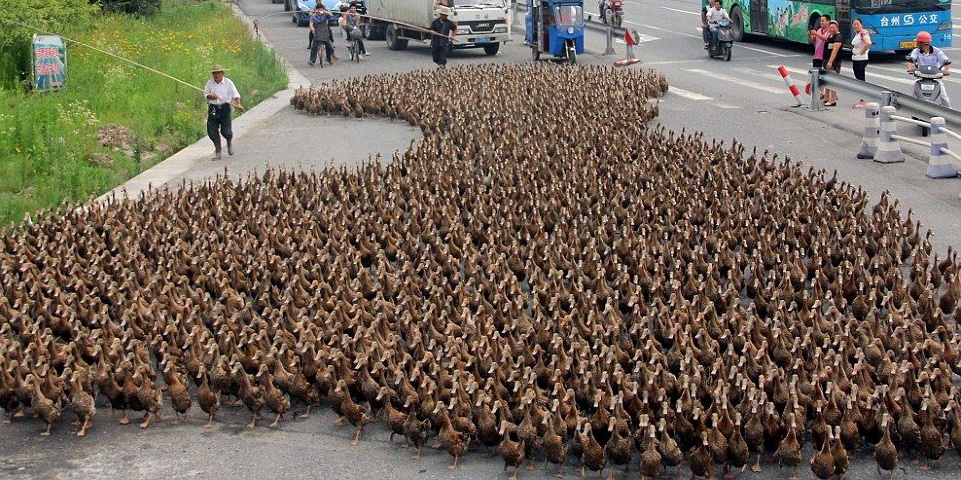
Mentre il fronte africano si affida alle tecnologie più avanzate, quello asiatico, con l’invasione delle cavallette tra India e Pakistan, si affida alla Natura. I cinesi, consapevoli che l’esercito delle locuste si prepara all’occupazione loro territorio hanno schierato la cavalleria: 100mila anatre ben addestrate all’attacco di cavallette vive.
Anatre in Cina. Vengono addestrate contro l’invasione delle locuste
Hanno già fatto varie ricognizioni in Pakistan e stanno spostando l’armata in quel Paese. La scelta era tra le anatre e le galline e hanno scelto le prime. Ognuna di queste riesce a ingurgitare fino a 200 cavallette al giorno, a differenza delle galline che ne mangiano “solo” una settantina.
Previsioni agghiaccianti
Nell’Africa orientale ormai le cavallette hanno superato i 100miliardi di insetti e in Kenya e nel Corno d’Africa una seconda generazione di locuste sta ampliando la famelica invasione. I Paesi africani oggi sotto attacco delle locuste per il momento sono otto: Eritrea, Etiopia, Gibuti, Somalia, Kenya, Uganda, Sud Sudan e Congo-K. E le coste egiziane e sudenesi del Mar Rosso sono state già “toccate” da gruppi e bande di cavallette.
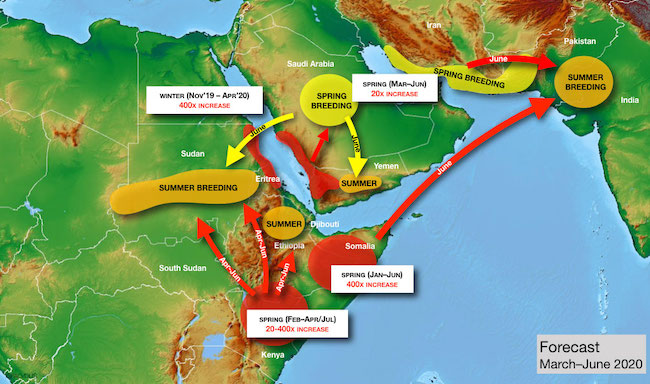
Previsione della crescita delle locuste del deserto per la primavera 2020 (Courtesy FAO)
Dati FAO, aggiornati al 5 marzo, danno previsioni agghiaccianti: per la primavera 2020 prevedono un aumento delle cavallette tra 20 e 400 volte. Un’armata che può crescere da 2mila miliardi a 4mila miliardi di cavallette.
Il risultato è solo uno: una carestia che colpisce una popolazione di 25milioni di persone.
Speciale per Africa ExPress Monica Mistretta
9 marzo 2020
Sono le 20 dell’8 marzo, è la festa della donna. A Rimini si respira un’atmosfera spettrale. La città è blindata: bar, ristoranti, locali hanno le serrande abbassate, le insegne spente. Le strade sono deserte. La poca gente che ha avuto il coraggio di uscire di casa è sbigottita: meno di 24 ore prima il decreto del governo ha trasformato la città romagnola del divertimento in una zona rossa dalla quale non si può entrare e uscire. C’è incredulità, incertezza e mancano solo due mesi all’apertura della stagione vacanziera.
Sono 113 i contagiati in città, ma tutti sanno che le cifre sono destinate a salire. Mentre la mappa dei contagi da Covid 19 si allarga nel Nord Italia, la gente si interroga cercando di capire come e da che cosa difendersi in un mare di notizie che aumenta il panico e la confusione. Perché proprio Rimini?
Negli ultimi giorni sono in pochi ad aver prestato attenzione ai tabelloni del piccolo aeroporto della città, il Federico Fellini. Ma è proprio lì che potrebbe trovarsi una risposta a tanti interrogativi. Quei tabelloni hanno molto da raccontare.
È il 3 marzo, siamo in piena emergenza Coronavirus. Rimini non è ancora zona rossa, ma i numeri del contagio stanno salendo. Un aereo modello A306 della compagnia Iran Air proveniente dall’aeroporto internazionale Imam Khomeini di Teheran atterra all’aeroporto Federico Fellini nel pomeriggio dopo aver fatto scalo a Milano Malpensa. Anche nel capoluogo lombardo il contagio galoppa all’impazzata. Sul sito Flight Radar 24 il volo proveniente dall’Iran che ha toccato i due aeroporti italiani ha un nome: EP-IBB. Lo seguiamo.
Alle 18.40 l’aereo della Iran Air decolla in direzione di Teheran. Tre giorni dopo, il 6 marzo, tutto si ripete come da copione: l’arrivo dell’aereo da Teheran a Milano alle 12.36 e poi ancora lo scalo a Rimini e il ritorno verso l’Iran nel tardo pomeriggio.
In Iran il Coronavirus sta dilagando, quasi impossibile stabilire i contagi. Sono in pochi a fidarsi delle cifre fornite dal governo di Teheran che fin dai primi giorni dell’emergenza ha cercato di minimizzare la portata dell’epidemia. Ma anche così, con oltre 6.000 contagi ufficiali, il paese è il secondo focolaio nel mondo dopo la Cina. Eppure, mentre i voli diretti dal paese asiatico sono stati prontamente cancellati nei primi giorni dell’emergenza Coronavirus, per qualche oscuro motivo nessuno ha pensato di fermare quelli provenienti dal paese mediorientale.
I tracciati di Flight Radar 24 sono lì per chiunque li voglia seguire. E così scopriamo che lo scalo nel piccolo aeroporto Federico Fellini prima del viaggio verso Teheran è una modalità che si ripete di frequente. Il copione collaudato a Malpensa funziona anche nell’aeroporto londinese di Heathrow: nel pomeriggio del 3 marzo, mentre si sta svolgendo la pericolosa staffetta Teheran, Milano, Rimini, un aereo proveniente da Londra fa scalo nella città romagnola e riparte nella tarda serata in direzione dell’aeroporto Imam Khomeini. Nel pomeriggio dell’8 marzo, quando Rimini è ormai in piena zona rossa, la dinamica si ripete senza alcun ostacolo.
La cosa sconcertante è che proprio l’8 marzo i paesi europei hanno tardivamente deciso il blocco di tutti i voli da e per l’Iran. La notizia è passata in sordina: nessun grande titolo in prima pagina, come accaduto per i voli con la Cina. A raccontarcelo è stata l’agenzia di stampa iraniana Irna con un laconico trafiletto: “In riferimento alle restrizioni sui voli Iran Air messe in essere dall’Europa, per ragioni sconosciute tutti i voli della compagnia con destinazione Europa sono stati sospesi fino a nuovo aggiornamento”.
Molti Paesi mediorientali, come la Turchia, avevano bloccato i voli con l’Iran già il 24 febbraio. Da allora qui non è accaduto nulla: gli aerei provenienti dal secondo focolaio al mondo di Coronavirus hanno continuato a fare scalo in Italia. Lo stesso è avvenuto nel resto dell’Europa: Parigi, Francoforte, Amburgo.
I tracciati Flight Radar 24 sono inequivocabili: nei prossimi giorni sono in programma altri volti della Iran Air. Milano e Rimini restano al centro delle rotte.
Bloccare i voli dalla Cina non ha fermato il Covid 19. Sono gli scali a Rimini della compagnia nazionale iraniana che dovrebbero fare riflettere se non altro per la curiosa coincidenza dell’alto numero di contagi in città. Ma forse è tardi anche per le riflessioni: siamo il terzo focolaio nel mondo.
Leonardo Corbucci, amministratore delegato di AIRiminum 2014, società di gestione dell’aeroporto internazionale di Rimini e San Marino Ci ha mandato la seguente precisazione “In merito all’articolo pubblicato su AfricaExpress a firma di Monica Mistretta il giorno 9 marzo dal titolo “Nessuno ferma i voli Milano-Rimini-Teheran e l’Iran è il secondo focolaio del virus al mondo” si precisa che “I voli della compagnia Iran Air in transito presso l’aeroporto ‘Fellini’ di Rimini si si limitano ad effettuare semplici scali tecnici per rifornimento carburante senza effettuare sbarco dei passeggeri né dell’equipaggio”
Monica Mistretta precisa così anche lei: Nell’articolo pubblicato oggi c’era già un riferimento al fatto che non sussistono prove di un nesso tra lo scalo a Rimini e il contagio. Mi risulta, tra l’altro, che Iran Air abbia smesso di fare scalo a Rimini.
Avete tutta la mia solidarietà per quanto sta accadendo nella vostra città. Anche a Milano, dove normalmente vivo, la situazione è davvero tesa.
Sullo scalo tecnico, mi permetto di copiare qui il riferimento alle sanzioni americane su Iran Air: è il motivo della sosta a Rimini, dal momento che nessun aeroporto europeo vuole rifornire di carburante la compagnia iraniana con i rischi connessi. La sanzione è del 2018. Una successiva sanzione, più restrittiva, risale alla fine di dicembre 2019, quando i voli hanno cominciato a fare scalo a Rimini.
IRAN AIR (a.k.a. HAVAPEYMAYI MELLI IRAN; a.k.a. IRAN AIR PJSC; a.k.a. IRANAIR; a.k.a. IRANAIR CARGO; a.k.a. THE AIRLINE OF THE ISLAMIC REPUBLIC OF IRAN; a.k.a. “HOMA”), Iran Air Building, Mehrabad Airport, Tehran, Iran; Postal Box 13185-775, Tehran, Iran; Central Airlines Department of the Islamic Republic of Iran, Tehran Karaj Special Road, Beginning of Mehrabad International Airport, Tehran, Iran; Website www.iranair.com; alt. Website www.iranair.co.ir; Additional Sanctions Information – Subject to Secondary Sanctions; National ID No. 10100354259 (Iran); Registration Number 8132 [IRAN].
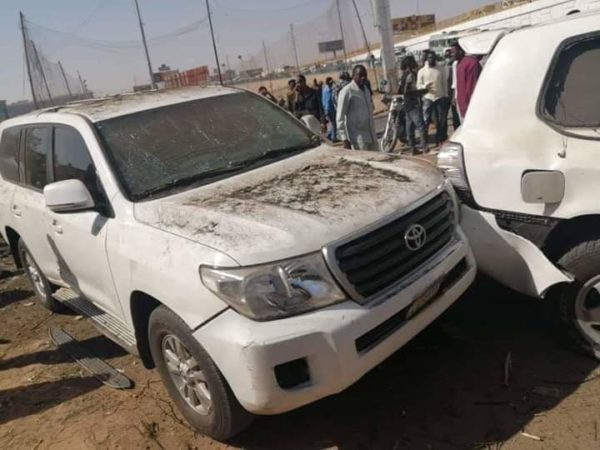
Il convoglio del primo ministro sudanese, Abdalla Hamdok, è stato colpito da un razzo RPG. Hamdok è sopravvissuto all’ attentato, e, secondo le prime informazioni, si troverebbe ora in un luogo sicuro.
Abdalla Hamdokrimo Ministro sudanese
L’attentato ha avuto luogo mentre il premier stava andando in suo ufficio. L’attacco finora non è stato rivendicato e indagini sono in corso. Terremo informati i lettori di Africa ExPress con ulteriori aggiornamenti.
Una vettura del convoglio dopo l’attentatoUn’altra vettura del convoglio di Hamdok, primo ministro sudanese
Speciale per Africa ExPress Massimo A. Alberizzi Nairobi, 8 marzo 2020
Un altro 8 marzo senza Silvia Romano. Ed è il secondo. Senza che nessuno faccia sapere qualcosa, nulla si muova, a parte qualcuno che alla ricerca di click e di “mi piace” di tanto in tanto lancia qualche notizia non verificata.
Purtroppo il rischio che sul sequestro della giovane volontaria milanese cali il silenzio totale è concreto. Se tutti ci scorderemo di Silvia saremo un po’ tutti responsabili della sua sorte. Su questo quotidiano online abbiamo scritto tutto ciò che è stato possibile verificare finora. Sappiamo che gli ultimi a vedere e parlare con la ragazza sono stati alcuni pastori orma (una tribù di origine somala) che pochi giorni prima del Natale 2018, cioè poco dopo il rapimento avvenuto il 20 novembre precedente, l’hanno incontrata assieme alla banda che l’ha portata via.
Silvia che al momento del sequestro era in canottiera, calzoncini corti, e senza scarpe, né ciabattine, era ferita, piena di graffi provocati dal bosco di acacie spinose che aveva attraversato a piedi. Aveva la febbre e delirava. I pastori hanno raccontato di averle dato da bere latte di capra, presumibilmente non bollito. Si può immaginare quale effetto abbia avuto sul corpo della giovane aggravandone le condizioni.
Silvia e il suo sorriso smagliante
Da quel momento di Silvia non si è saputo più nulla. Nella vicenda si sono inseriti sciacalli e truffatori che hanno tentato di estorcere denaro in cambio della promessa di fornire prove sulla prigionia della ragazza. Email con richieste di soldi sono state rivolte anche a noi di Africa ExPress. L’ultima proponeva di farci parlare al telefono con Silvia, se fosse stata versata una piccola cifra in bitcoin.
Non hanno tranquillizzato le parole del primo ministro Giuseppe Conte e del presidente della Repubblica Sergio Mattarella che hanno assicurato il continuo impegno delle nostre istituzioni per liberare la ragazza. Troppo vaghe e ripetitive agli occhi di molti. Appare chiaro a questo punto il fallimento totale del lavoro (se c’è stato) dei servizi segreti, della diplomazia e della politica sulla vicenda. C’è qualcosa il questa storia che non quadra. Si scontano anni di incuria nel non aver coltivato rapporti con le istituzioni e con i politici locali.
E’ possibile che anche i responsabili politici italiani, oltre che l’opinione pubblica, vengano tenuti all’oscuro di tutto? Persino il nostro ministro degli esteri, Luigi Di Maio, dice di non saperne niente. O meglio il “Siamo fiduciosi” e lo “Stiamo lavorando” non si negano a nessuno.
Quindi se Mattarella, Conte, Di Maio non ne sanno niente, chi sa qualcosa? I capi dei servizi segreti? Quelli dei carabinieri e/o della polizia?
Lo scenario che appare sotto gli occhi è inquietante e allarmante. E quindi da adito a ipotesi di ogni genere: per esempio che Silvia sia stata sacrificata sull’altare di interessi molto più grandi, per esempio concessioni petrolifere di grande portata e valore. Interessi che saranno pure di portata nazionale me che – secondo noi – non valgono la vita di una giovane italiana che poteva essere salvata subito se non fossero stati compiuti degli errori, alcuni clamorosi, come abbiamo già raccontato.
E sorge ancora spontaneo il dubbio che questo inquietante silenzio sia stato sollevato proprio per coprire imperdonabili errori commessi.
E oggi, 8 marzo, speriamo ancora che qualcuno si muova e sciolga questo mistero prima che l’oblio cali definitivamente il sipario sulla vicenda. Festeggiamo le donne, sì tutte le donne, ma soprattutto quelle che hanno sofferto o stanno soffrendo. E Silvia e una di queste.
L’11 e 12 marzo sono previste le ultime due udienze del processo che vede coinvolti alcuni dei rapitori di Silvia. Africa ExPress ci sarà per raccontarvi se dagli interrogatori è uscito qualcosa di nuovo, compreso il nome del vero mandante del sequestro.
Speciale per Africa ExPress Cornelia I. Toelgyes
7 marzo 2020
La Mauritania, come abbiamo già scritto nel nostro articolo di due giorni fa, ha deciso di chiudere le frontiere per i cittadini di 4 Paesi: Cina, Corea del Sud, Iran e Italia. Ma le misure non erano ancora state applicate al momento dell’ atterraggio di 15 italiani a Nouakchott, nella notte tra il 29 febbraio e il 1° marzo, come erroneamente abbiamo pubblicato il 5 marzo. Africa ExPress aveva ripreso la notizia dall’agenzia di stampa France Presse, rimbalzata su molti quotidiani internazionali.
Persino Abel Ghader Ould Ahmed, responsabile delle comunicazioni del ministero della Sanità ora ha smentito sul suo profilo Facebook il fatto che i 15 italiani siano evasi dalla quarantena e poi scappati. Sarebbe stata comunque un’impresa assai complessa e difficile, visto che la comitiva era composta da persone non più giovanissime.
Africa ExPress ha raggiunto telefonicamente uno dei componenti del gruppo, partito dall’Italia alla volta della Mauritania con la moglie. Angelo Serrau ha riferito che al momento della partenza il provvedimento del governo mauritano non compariva né suoi siti internazionali, tanto meno su quelli del tour operator Antichi Splendori di Torino e del suo corrispondente in loco, Mauritania Kanaga Adventure.
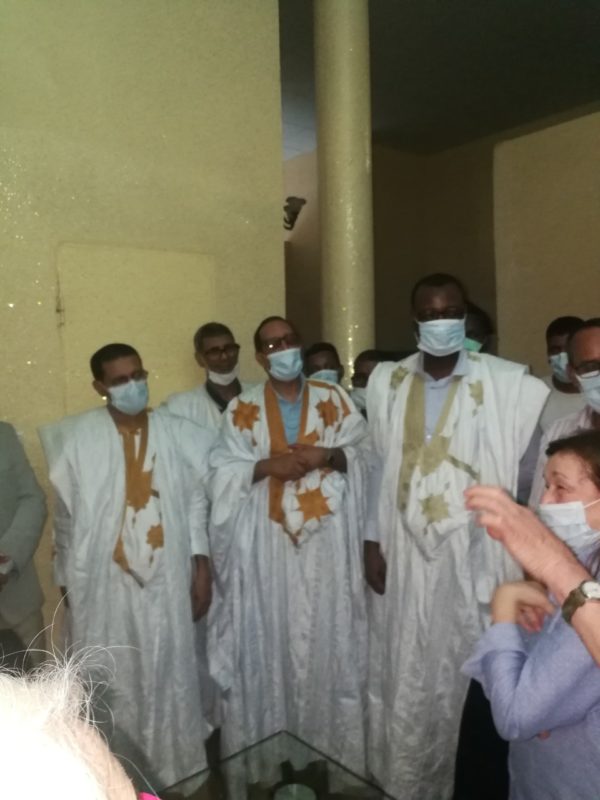
Foto scattata da Angelo Serrau durante la visita dei ministri alla comitiva degli italiani: il primo a sinistra, il ministro della Sanità, Nezhirou Ould Hamed; l’ultimo a destra, Mahmoud Sid’Ahmed, ministro del Commercio e Turismo
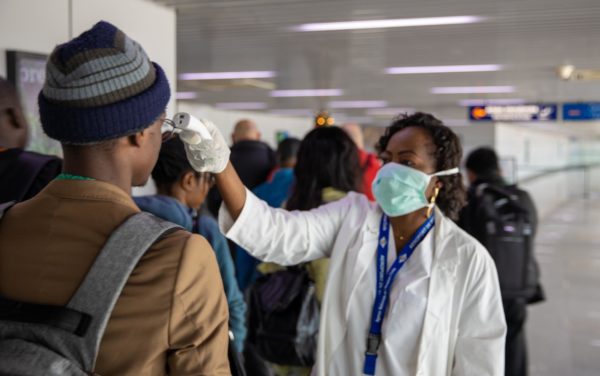
“E’ assolutamente falso che le autorità mauritane ci abbiano imposto la quarantena appena atterrati. Al nostro arrivo in aeroporto ci hanno misurato la febbre, abbiamo compilato un formulario dichiarando di non essere stati in Cina nelle ultime due settimane e in seguito ci è stato rilasciato regolare visto d’entrata, senza alcuna limitazione di movimento. Verso le 3 del mattino abbiamo poi raggiunto l’albergo Semiramis con i mezzi del tour operator locale. La mattina seguente siamo partiti, come da programma, distribuiti su 5 automezzi alla volta di Atar. Abbiamo superato senza problemi 3 blocchi stradali della gendarmeria, mentre al 4° ci è stato chiesto di far ritorno nella capitale per non precisati controlli medici”.
Angelo Serrau prosegue nel suo racconto: “Siamo stati portati in un edificio a 4 piani e la nostra guida, in contatto con le autorità mauritane, ci ha comunicato che siamo stati messi in quarantena, a meno che non volessimo ritornare immediatamente in Italia. Opzione che ovviamente abbiamo scelto”.
Nel tardo pomeriggio di domenica 1° marzo ben 2 ministri mauritani: Nezhirou Ould Hamed, ministro della Salute pubblica e Mahmoud Sid’Ahmed, ministro del Commercio e del Turismo hanno raggiunto il gruppo italiano. Entrambi si sono scusati con i nostri connazionali per aver interrotto così bruscamente il loro viaggio e hanno promesso uno sconto sul biglietto di ritorno del 50 per cento.
Controlli rafforzati anche in molti aeroporti africani
Il coronavirus sta invadendo alcuni Paesi africani, anche se per il momento sono ancora pochi quelli che hanno registrato casi confermati. Ieri alla lista si è aggiunto il Camerun. Il primo ammalato è un francese, arrivato il 24 febbraio con un volo Air France che ha fatto scalo a Bangui, la capitale della Repubblica centrafricana. Lo ha fatto sapere il ministero della Sanità di Yaoundé ieri sera e poche ore più tardi è stato identificata una seconda persona con l’infezione virale, un camerunense venuto in contatto con il cittadino d’Oltrealpe.
Mentre i Paesi del continente che non sono ancora venuti in contatto con SARS-CoV-2, si stanno preparando e alcuni di loro hanno già emanato misure straordinarie, come il Burundi, che impone la quarantena ai cittadini provenienti da Cina, Corea del Sud, Iran, Italia, Germania, Francia, Giappone e Spagna, inoltre chiede ai burundesi di limitare gli spostamenti.
Anche il ministero della Salute del Ciad ha chiesto maggiori controlli a tutti i valichi, in particolare all’aeroporto di N’djamena, che è la principale porta d’entrata del Paese.
Il presidente del Senegal, Macky Sall, ha vietato ai suoi ministri di uscire dal Paese per evitare il rischio di contagio. Al momento attuale sono quattro i malati nel Paese. Il primo, quasi guarito, potrà lasciare presto la clinica dove è ricoverato in isolamento. Dal 4 marzo non ci sono stati nuovi casi, dunque, seconto le autorità competenti, i dispositivi messi in campo sembrano portare i loro frutti. E Moussa Seydi, capo-servizio dell’ospedale Fann di Dakar ha precisato che lui e la sua équipe sono pronti a affrontare un’eventuale epidemia. Il governo metterà a disposizione 2 milioni di euro per la lotta contro il coronavirus.
Cornelia I. Toelgyes corneliacit@hotmail.it
@cotoelgyes
Un pensiero in musica, dedicato a tutte le Donne del mondo. Salutiamo qui in particolare coloro che attualmente vivono in zone di conflitto, costrette a lasciare la loro terra con i loro bambini, affrontando con coraggio e determinazione la loro condizione; alle operatrici umanitarie, infermiere, dottoresse, sempre in prima linea per tendere la mano, noncuranti dei pericoli ai quali si espongono.
Un grande abbraccio e grazie sempre da Shaggy e tutti noi di Africa-ExPress
Speciale per Africa ExPress Monica Mistretta 7 marzo 2020
Erano i primi giorni di febbraio e il virus conosciuto con il nome scientifico di Covid-19 stava dilagando in Cina con una rapidità impressionante. Le immagini degli ospedali stracolmi di malati e le centinaia di cadaveri coperti da un telo azzurro riempivano i notiziari e le prime pagine dei giornali di tutto il mondo. Le compagnie aeree internazionali stavano interrompendo in quelle ore tutti i voli con la Cina; chi veniva dal Paese asiatico, una volta sbarcato, era messo in quarantena.
In Iran gli ayatollah seguivano con apprensione l’evolversi della situazione: da quando nel maggio del 2018 l’amministrazione Trump ha imposto le nuove sanzioni sul Paese, la Cina per Teheran è diventata economicamente indispensabile. Ma le immagini dei morti per il misterioso Coronavirus in quei giorni cominciano ad arrivare anche sugli schermi delle Tv iraniane e nella prima settimana di febbraio il ministro della Salute, Saaed Namaki, annuncia un blocco temporaneo di tutti i voli da e per la Cina.
Pochi giorni dopo i tweet in Iran si scatenano: i voli tra i due Paesi asiatici non si sono interrotti, anzi. La Mahan Air, una compagnia privata messa sotto sanzioni statunitensi per il suo ruolo nei traffici di armi e i legami con il Corpo delle Guardie Rivoluzionarie Islamiche, continua a fare la spola con la Cina.
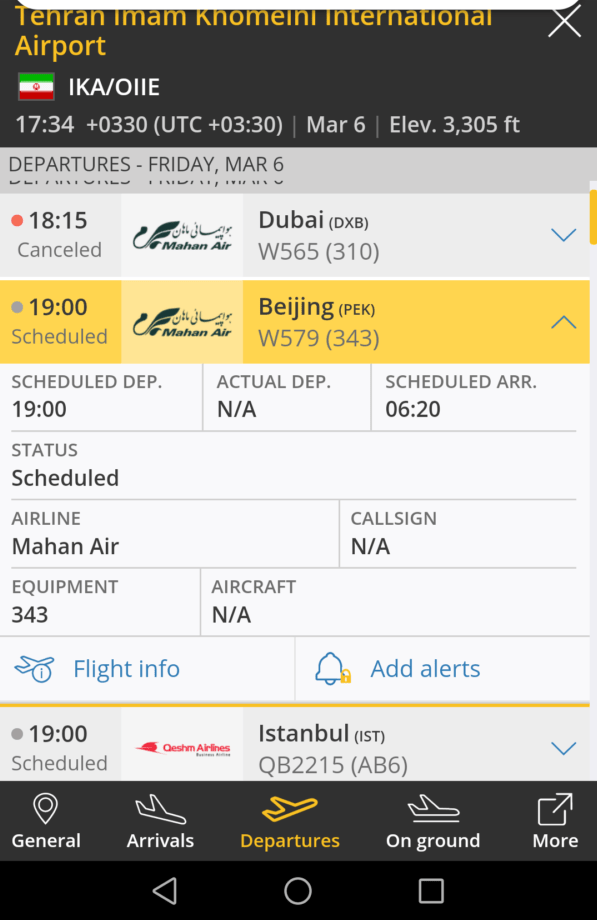
Giornalisti e rappresentanti del governo a Teheran denunciano pubblicamente la situazione. Ma gli aerei della Mahan Air, a dispetto della interruzione ufficiale dei voli per la Cina fino al 17 marzo, non si fermano. Anche in queste ore, mentre stiamo scrivendo, un volo della compagnia aerea è appena decollato dall’aeroporto internazionale Imam Khomeini di Teheran con destinazione Pechino.
Due giorni fa tra i nomi delle vittime del nuovo Coronavirus l’agenzia di stampa ufficiale iraniana Irna deve aggiungere anche quello di Hossein Sheikholeslam, uno dei consiglieri del ministro degli Esteri, ex ambasciatore in Siria, divenuto celebre durante la crisi degli ostaggi all’ambasciata statunitense nel 1979. Le persone colpite dal virus sono migliaia, il governo di Teheran sta valutando l’uso della forza per fermare il contagio.
La Mahan Air, la compagnia aerea iraniana che va e viene ininterrottamente dalla Cina, è legata a doppio filo alle Forze Quds delle Guardie Rivoluzionarie Islamiche, quelle, per intenderci, responsabili delle operazioni coperte all’estero per conto di Teheran. O, se preferite, quelle che adesso sono impegnate nell’ultima, complicata fase della guerra siriana a Idlib che vede la Siria di Assad schierata al fianco di russi e Iran contro la Turchia. Ed è questo il punto: a Idlib la Cina ha un grosso problema da risolvere.
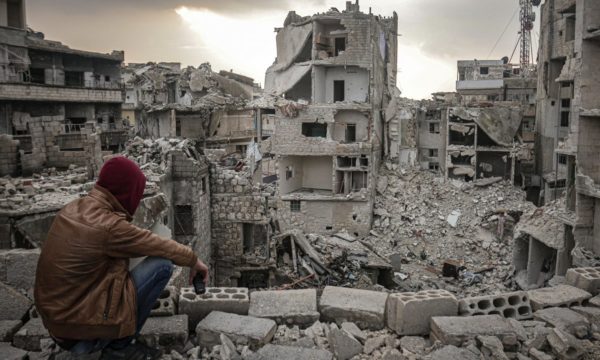
La città siriana di Idib semidistrutta dai bombardamenti
Nella provincia della Siria al confine con la Turchia tre le decine di milizie finanziate dal governo di Erdogan ci sono anche migliaia di cinesi. Sono gli uiguri, una minoranza etnica musulmana sunnita della provincia cinese dello Xinjiang. Molti di loro, perseguitati nel loro Paese, si sono rifugiati in Siria all’inizio della guerra civile e hanno preso le armi al fianco dei turchi contro Damasco. L’incubo della Cina è che facciano ritorno a casa. Per questo, Pechino è disposto a fornire armi, soldi e assistenza militare illimitata a chiunque li combatta, primo fra tutti l’Iran.
I voli della Mahan Air non potevano fermarsi a febbraio, nel pieno dell’escaltation militare a Idlib. Armi e mezzi dovevano fluire in Siria in soccorso di Assad e delle milizie iraniane impegnate sul campo contro i turchi e i loro alleati uiguri. Peccato che il Covid-19, per espandersi, non abbia atteso gli interessi di nessuno.
Special for Africa ExPress Makeda Saba
Somewhere inside Eritrea, 5 March 2020
On 18 February 2020 during the EU parliamentary session, the EU Committee on Development (DEVE), questioned the EU’s decision to fund the Eritrean Government for the reconstruction and rehabilitation of roads connecting Eritrea and Ethiopia.
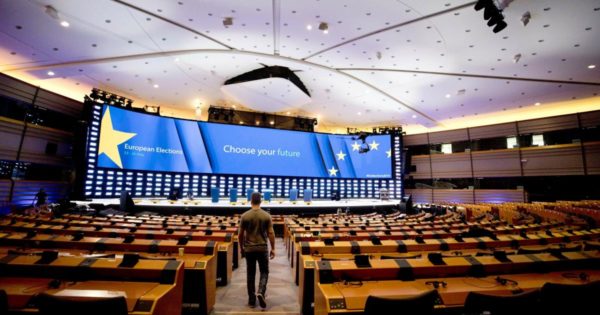
European Parliament
There are two projects with the title – ‘Reconnecting Eritrea and Ethiopia through the main roads’. They are to be implemented in two phases: (i) Phase 1 – EUR 20 million – approved 31 January 2019 (TO5 -EUTF – HOA-ER-66); (ii) Phase 2 – EUR 60 million approved 31 December 2019; (TO5 -EUTF-HOA-ER-86). A total of EUR 80 million. The approval of the second phase (EUR 60 million) happened despite the objections raised by human rights activists including the Foundation Human Rights for Eritreans.
Both projects state that the EU’s overall objective is to: “…… [rehabilitate the main arterial roads] in Eritrea in order to help the peace and economic reintegration between Eritrea and Ethiopia”. They also state that: “…. [providing] Ethiopia access to Eritrea’s ports is a key priority.” (TO5 -EUTF – HOA-ER-66; TO5 -EUTF-HOA-ER-86).
According to the EU, their intervention in road rehabilitation and construction in Eritrea will also address the following:
EU Trust Fund
Strategy
Valetta Action Plan-
UN Sustainable Development Goals (SDG)
1) Greater economic and employment opportunities
1) Development benefits of migration and addressing root causes of irregular migration and forced displacement
1. Enhance employment opportunities and revenue generating activities
2. Link relief, rehabilitation and development tin peripheral and most vulnerable areas
1) SDG 1- End Poverty
2) Strengthening resilience of communities and in particular the most vulnerable, as well refugees and displaced people
2) SDG 2 – End hunger achieve food security and improved nutrition and promote sustainable agriculture
3) SDG 8 – Promote sustained inclusive and sustainable economic growth, full and productive employment
4) SDG 9 – Build resilient infrastructure, promote inclusive and sustainable industrialization and foster innovation
5) SDG 16 – Peace justice and strong institutions
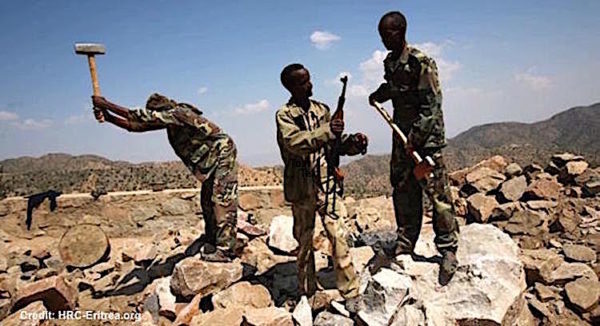
The fiche for the projects state that: the EU is funding the procurement of road construction equipment and materials through the Red Sea Trading Corporation (RSTC). Such procurement is to be undertaken with the assistance of UNOPS. The projects are to be implemented by the Government of Eritrea, who will work through People Front for Democracy and Justice (PFDJ) owned companies as well as through the deployment of National Service Conscripts and Community Mobilisation.
National Service and Community Mobilisation as carried out by the Eritrean Government are all modes of deploying human resources that the UN Human Rights Commission of Inquiry as to Human Rights in Eritrea (2015) found to constitute forced labour. “ (A/HRC/29/CRP.1; 2015)[i]The projects justify the use of forced labour and therefore, the lack of any attempt to take steps to reform the National Service by advancing the Eritrean Government’s own excuse that the current economic realities of the country preclude starting any reform of the National Service.
Eritrea: Forced labour
The existing dire economic realities of the country and, the fact that Eritrea has become an open-air prison, are a direct consequence of ruling party’s, the Peoples Front for Democracy and Justice (PFDJ), own policies. And, specifically its insistence on the continued implementation of failed policies such as : (i) National Service and its indefinite extension through – forcing students to complete grade 12 at the Sawa Military Camp, the Warsay Yikaalo National Development Programme, the People’s Army; (ii) the takeover of all economic sectors by PFDJ owned entities, displacing and weakening the independent private sector.
Since signing the Declaration of Peace with Ethiopia (09 July 2020), the Eritrean Government is skilfully changing its narrative, on the issue of National Service, to suit the situation. For more than twenty years it has maintained that National Service was necessary because of the Ethiopian threat. Now, it justifies the continuation of indefinite National Service alternatively on the basis of economic constraints and the existential threat posed by the Tigray People’s Liberation Front (TPLF) an entity that President Isaias is determined to destroy irrespective of who is damaged in the process.
On 1 April 2019, the Foundation for Human Rights for Eritrea, a Netherland based Eritrean organisation, concerned that the EU is financing activities in Eritrea for which forced labour is used and that, such action is in clear violation of human rights and the EU’s adherence to international and legal obligations, started legal action against the EU.[ii] This action has contributed to raising the awareness of the international media and human rights organisations as well as of the EU Committee on Development (DEVE). Therefore, contributing to the questioning of the EU funding of the road rehabilitation projects in Eritrea during the EU Parliamentary session of 18 February 2020.
At that Parliamentary session, Human Rights Watch (HRW) [iii] referred to the EU’s 2016 [iv]and 2017[v] resolutions, whereby the human rights situation in Eritrea was deemed to be one of extreme repression. And, specifically HRW aptly reminded the EU that: “…. [national service] is not only used as a form of ‘employment’ in an unquestionably, dire economic context, butas the main instrument of repression that the government uses to control almost every single aspect of its citizens’ lives.”[vi]
It is remarkable that the EU, who has on numerous occasions described the human rights situation in Eritrea as dire, is now directly supporting a road rehabilitation and construction project that will be implemented through the use of forced labour. A mode of operation that the UN Human Rights Commission of Inquiry has found to be linked to: “…. systematic, widespread and gross human rights violations “. The Commission also found that: “Some of these violations may constitute crimes against humanity.” (A/HRC/29/CRP.1; 2015) [vii]
By 2016, the same UN Commission states that: “… [crimes against] humanity namely, enslavement, imprisonment, enforced disappearance, torture, other inhumane acts, persecution, rape and murder, have been committed in Eritrea since 1991.”. In addition, the Commission recommends that: “…. [the African Union] establish an accountability mechanism, ………to investigate, prosecute and try individuals reasonably believed to have committed crimes against humanity.” [A/HRC/32/47][viii]
Both the 2015 and the 2016 UN Commission of Inquiry as to Human Rights in Eritrea reports and, the subsequent UN Human Rights Special Rapporteur for Eritrea reports, identify National Service with all its extensions (i.e. Completion of Grade 12 at the Sawa Military Camp; Warsay Yikaalo National Development Programme, People’s Army) as the key reason for Eritreans fleeing their country. Despite this and, as already mentioned the EU’s own misgivings as to human rights situation in Eritrea, the first major EU funding, following the signing of the Eritrea /Ethiopia – Joint Declaration of Peace is to, fund projects that rely on deployment of National Service Conscripts and by implication forced labour.
It is also remarkable that, the procurement of equipment and materials for the road projects is to be carried out by the Red Sea Trading Corporation (RSTC), identified by the EU as a central procurement authority of the Government of Eritrea and that, in the process of implementation of the projects the RSTC’s capacity will be strengthened.
Contrary to the EU’s assertion, the RSTC is not the central procurement agency of the Government of Eritrea. It is a fully owned company of the ruling party, the Peoples Front for Democracy and Justice (PFDJ). During the liberation struggle, the RSTC was section 09 of the Economic Department of the Eritrean People’s Liberation Front (EPLF) now PFDJ. Presently, the company has the monopoly over import /export activities in Eritrea.
The RSTC, whose capacity development is funded by the EU road projects, is an entity that the Somalia Eritrea Monitoring Group (SEMG), has identified as being part of the Eritrean Government’s controlled informal economy that, transacts mostly in hard currency and is predominantly located offshore through what has been described as: “…… [a labyrinthine] multinational network of companies, individuals, and bank accounts…… “. In addition, the RSTC is recognise as an entity that:” …. [routinely] engages in ‘grey’ or illicit activities.” (SMEG; S/2011/433) [ix]
Since independence, the PFDJ, has systematically destroyed any separation between itself and the State of Eritrea, has never published a budget and continues to maintain a fungible and informal economy that relies on: “…[hard currency] transactions through an obscure, non-transparent network of business entities that are owned by the State and managed by senior officials of the Government, PFDJ and the military…...”(SMEG; S/2015/802E)[x].It, has created a situation whereby, the finance department of the party is acting as the National Treasury and the Red Sea Trading Corporation as the National Procurement Agency. (SMEG; S/2011/433) [xi]
Concerned as to the mode of engagement of the EU with the Eritrean Government and, the possibility of direct funding of the Government, the Somali Eritrean Monitoring Group (SEMG) approached the European Commission to seek assurances. The Group received:” ……[the] highest assurance that the European institutions were implementing strict monitoring and auditing procedures to ensure that aid was provided only to the people and that no direct support was provided to Government.” (SMEG; S/2015/802).[xii]The EU, reassured the SMEG that bulk of EU funds was distributed to support social and economic development, including good governance. .[xiii]
Neither of the EU road rehabilitation and construction projects (TO5 -EUTF – HOA-ER-66; TO5 -EUTF-HOA-ER-86) are in line with the reassurances given by the EU to the SEMG. And, neither project address the issue of forced labour a key source of human right abuse and a key driver of Eritrean Exodus.
The projects referred to by the EU in their reassurances to the SMEG, were part of the 11th European Development Fund – National Indicative Programme 2014-2020 (NIP). This programme allocated Euro 200 million for Eritrea as follows: (a) Euro175 million for Sustainable Energy; (b) Euro 25 million Governance supporting measures.
The development of the NIP was monitored by the EU Parliament’s Committee on Development (DEVE) who, has recommended that the Programme not be adopted pending further discussions. The recommendation was made because of concerns as to the: “…. [the scale ] and seriousness of the human rights violations committed by the Eritrean regime, the lack of reliability of this regime as a development cooperation partner, the pervasive corruption and the virtually total absence of transparency in public financial management in the country, and the risk of misusing EDF funds for migration management ; ……[the Committee on Development] called on the EDF Committees not to adopt the NIP pending further discussion…” (P8_TA(2016)009) [xiv]Irrespective of these concerns, NIP was signed on 28 January 2016.The document makes no reference to the findings of the UN Human Rights Commission of Inquiry as to Human Rights in Eritrea and the reports of the Human Right Special Rapporteur on Eritrea.
NIP 2014-2020, was the first EU/Eritrea cooperation agreement to be signed since November 2011, when the Eritrean Government suspended EU cooperation programmes. According to the EU statement at the time (15 November 2011),[xv] the Government of Eritrea justified the suspension as part of a process of reviewing and finalizing:” …. (the country’s) five-year National Development Plan before engaging in cooperation with the EU as a partner….”.
The programmes cancelled were: (i) EUR 37 million in support of agriculture; (ii) EUR 5 million in support of Community Courts; (iii) EUR 3.4 million in support of training of public servants; (iv) EUR 5 million in support of national heritage; (v) EUR 68.3 million that had not been contracted. A total of EUR 118.7 million.
The Eritrean Government’s, unilateral suspension of EU funded programmes in 2011, was not an isolated case. It was, and is, part of a pattern of behaviour recurring at regular intervals since independence. Some examples of this patterns the closure of National and international NGO’s (1997; 2005; 2011); the expulsion of diplomats [xvi]. Preventing a British Diplomat from leaving the country and arresting a national working for the British Council because, of a dispute over the Council’s plan to install a satellite internet link connecting all of its offices. Because of the dispute, the Council ceased operations in Eritrea in 2011[xvii]. The Eritrean Government has also closed USAID[xviii] and WFP[xix] and last year it closed the Catholic Church Health Facilities[xx] and, Catholic and Muslims Schools. At the same time, it has continued to arrest dissenters such as former Minister of Finance Abrehe Kidane Berhane as well as Pentecostal Christians and Orthodox Monks.[xxi]
Following the signing of the Declaration of Peace and Friendship between Eritrea and Ethiopia: “…the EU member states encouraged the EU to pursue a dual track approach……” [xxii]. Track one is focused on: (i) Resumption of political dialogue with Government; (ii) Reforms of National Service and Human Rights; (iii) Addressing economic and regional issues of mutual interest. And, Track two is focused on: (i) Reinforcing the peace agreement with Ethiopia; (ii) Regional Economic integration; (iii)Creation of conducive environment to facilitate internal reforms.
During the EU Parliamentary session of 18 of February 2020, the European Commission Representative, Sandra Kramer, explained that road construction is a priority of the Eritrean Government and that, EU support for the purchase of equipment and material is in fact reducing the hazard of the work. Therefore, suggesting that the EU has a positive impact on the work conditions of the National Service conscripts, because the equipment purchased with their funding would make the work safer and reduce the labour. These assertions completely overlook the fact that in Eritrea, the National Service is the source of human rights abuses and is an instrument of repression of Eritreans.
The EU dual track and health and safety approach to engagement with Eritrea, is not novel. It has been tried before and has failed miserably because, the Eritrean Government has no intention of admitting its failures or changing its approach. [xxiii]
The dual track and, the health and safety approach was tried by UNDP with the Mine Action Capacity Building Programme 2000-2005. The programme made a concerted effort to mitigate the labour situation of the Eritrean deminers, who were National Service conscripts, assigned to the Eritrean Demining Authority (EDA) and the Eritrean Demining Organisation (EDO).
The Mine Action Capacity Building programme provided highest quality equipment; ensured international level health and safety standard for the deminers; and provided food and medical support for the demining teams. There was dialogue at all levels of the Eritrean Government. This was all done in the hope of effecting longer term change such as demobilisation. Irrespective of the efforts made, in 2005 the deminers were ordered to report to their military units, materials and equipment were seized and the programme was eventually closed. The Eritrean Government took such action, despite the fact that much of Eritrea is impacted by landmines.
In pursuit of the two-track approach, the European Development Fund (EDF) Committee, on 13 March 2019, unanimously approved the transfer of EUR 180 million from the EDF 11- National Indicative Programme -2014-2020 (NIP) to EU Emergency Trust Fund for Africa (EUTF)[xxiv]. The NIP funds had remained unallocated. The EU justification for the transfer of funds from the NIP programme EUTF is that:” The dual track approach requires swift and nimble cooperation arrangements, such as those provided by the EUTF, to deliver within short timeframes. Standard EDF programming procedures are not designed to deliver effectively on the dual approach.”.
However, it is also the case that such transfer removes the fund from the oversight normally exercised by the EU Parliament and specifically the supervision of the EU Committee on Development (DEVE) who, even in the case of the NIP had expressed concerns and who even while conceding on the NIP called on the EU Commission to: “…[ensure that the funding allocated does not benefit the Eritrean Government but is strictly assigned to meeting the needs of the Eritrean people for development, democracy, human rights, good governance and security and freedom speech…” [xxv]
The concern as to the oversight of the EUTF instruments is highlighted by Oxfam in its 2017 report – “An Emergency for Whom? The EU Emergency Trust Fund for Africa: migratory routes and development aid in Africa”, In the report, the EUTF is described as:” … [a fungible] instrument.” where: “… [no project] can be directly connected to a specific source of funding.”.[xxvi]The report also expresses concern that the aggregation of the various rules that apply to EU funding sources creates a situation of lack of transparency and accountability. A situation that is further aggravated by the fact that neither the European Parliament nor the Committee on Development (DEVE) has any role in providing input and meaningfully supervise how EU resources are spent. On this issue the situation has not improved. According to Oxfam’s, 2020 report “The EU Trust Fund for Africa: Trapped between aid policy and migration politics”[xxvii], while communication about the EUTF for Africa has improved and the fund remains a flexible tool, the monitoring and oversight concerns remain.
Hence, in the case of Eritrea, the combination of the dual track approach and the EUTF funding mechanism provide the necessary tools for the EU member states to prioritise political concerns as to migration and EU relevance in the Horn of Africa, while at the same time assuring minimal to no oversight by the EU Parliament and Committee on Development (DEVE). A fungible arrangement overlooking the role of the Eritrean Government in the repression of its own people.
During their recent testimony to the EU Parliament, Human Rights Watch (HRW) warned the EU that: “…. [any] engagement with the Eritrean risk bringing the European Commission into a minefield of human rights issues…” [xxviii]. In fact, in their letter of Summons to the EU, Foundation Human Rights for Eritrea, points out that; pursuant to the EU Charter of Fundamental Rights, the EU is required to respect human right (Article 51(1)). And, that according to Article 21 of the European Union External Human Rights Commitment (TUE), the EU is required to ensure that that all of its international action comply with fundamental human rights principles accepted in international law. Finally, the EU Charter of Fundamental Rights, prohibits the use of forced labour (Article 5(2). Therefore, the construction and rehabilitation of roads in Eritrea is contrary to EU legal and regulatory framework.
The situation is best summarised by Mr. Emiel Jurjens, human rights attorney-at-law at Kennedy Van der Laan (Amsterdam) [xxix]: “Financing projects which make use of forced labour is a clear violation of human rights. The EU must stop these activities immediately and fundamentally rethink its approach to Eritrea, taking into account all evidence which points towards serious human rights violations in the country…”
Speciale per Africa ExPress Cornelia I. Toelgyes
5 marzo 2020
Un gruppo di 15 turisti italiani sono evasi dalla quarantena in Mauritania. Il governo di Nouakchott ha immediatamente firmato il decreto di espulsione e li ha rinviati al mittente, tramite un volo via il Marocco. La notizia è stata confermata a AFP (Agence France Presse) dal portavoce del ministero degli Esteri, Abdelkader Ould Ahmed, che ha aggiunto: “Hanno fatto l’errore di eludere la quarantena imposta dal ministero della Salute per arginare il pericolo coronavirus nel nostro Paese”. Tali misure vengono applicate a tutti viaggiatori provenienti da Paesi a rischio, e, ahimè, l’Italia è tra questi.
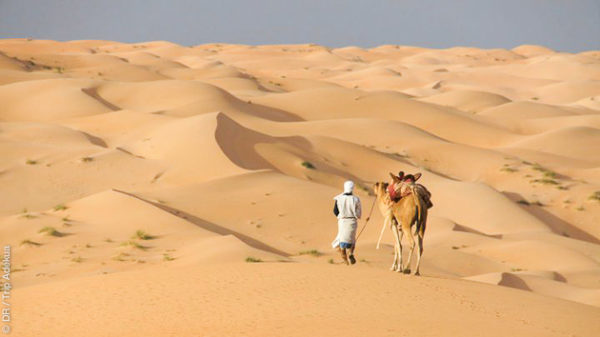
Deserto della Mauritania
I nostri concittadini sono arrivati sabato scorso nella capitale mauritana, per raggiungere il sito turistico di Atar (significa “Strada” nella lingua Azer e “Città nuova” nella lingua berbera) nel centro-occidentale della ex colonia francese. La città si trova nella zona montana dell’Adrar, sulla strada carovaniera per il Marocco e vanta una delle moschee più antiche del nazione.
Sabato, giorno del loro arrivo, il gruppo è stato subito fermato dalle autorità sanitarie, che hanno imposto loro la quarantena. Sono stati immediatamente accompagnati in un albergo della capitale, nell’attesa di individuare un luogo adatto per l’isolamento. Domenica mattina gli italiani hanno tentato la fuga in gran segreto, cercando di raggiungere Atar. Per loro sfortuna sono stati intercettati dopo aver già percorso una novantina di chilometri.
Il governo mauritano ha decretato ieri il divieto d’entrata a cittadini di 4 Paesi: Cina, Corea del Sud, Iran e Italia.
Attualmente nel continente africano sono sei i Paesi che stanno affrontando in modo diretto l’infezione da COVID-19: Egitto, Algeria, Nigeria, Senegal, Tunisia e Marocco. In Marocco è stata annullata la gara ciclistica Tour du Maroc cycliste 2020, che si sarebbe dovuta svolgere dal 9 – 18 aprile, come pure il Grand Prix de judo de Rabat, programmato dal 6 – 8 marzo.
Il Senegal ha registrato martedì il secondo caso di contagio. Si tratta di un francese di 80 anni, arrivato nel Paese il 29 febbrario. Per questioni di sicurezza sono stati momentaneamente sospesi alcuni eventi.
Il primo paziente del Marocco è un cittadino marocchino, rientrato da poco dall’Italia. Secondo le autorità del regno le sue condizioni non destano preoccupazione.
Stessa cosa Tunisia: un cittadino tunisino, appena arrivato in patria via mare dall’Italia, dopo aver presentato i primi sintomi, è stato sottoposto al test, che è risultato positivo all’infezione.
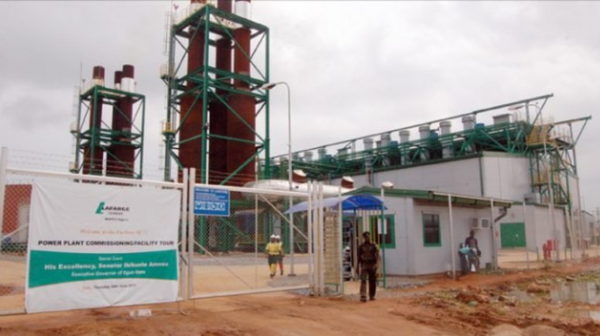
Cementificio Lafarge chiuso momentaneamente per coronavirus (Ogun State,Nigeria)
In Nigeria il governo ha deciso di mandare in vacanza tutti i membri del Parlamento per quindici giorni per garantire la massima sicurezza sanitaria ai propri deputati. Il primo caso di coronavirus è stato registrato la scorsa settimana in Ogun State. Si tratta di un italiano, arrivato nella ex colonia britannica il 24 febbraio scorso.
E terminiamo con una notizia positiva: nella Repubblica Democratica del Congo è stato dimesso oggi l’ultimo paziente di ebola. Sembra ormai sconfitta la 10ma epidemia della febbre emorragica che messo in ginocchio due province, Nord-Kivu e Ituri dal 1° agosto 2018. Anche l’Organizzazione mondiale della Sanità si dichiara soddisfatta e il direttore generale Tedros Adhanom Ghebreyesus ha detto che nelle ultime due settimane non ci sono stati nuovi casi. Se nessuno dovesse essere contagiato nei prossimi 42 giorni, l’OMS potrà finalmente dare il sospirato annuncio: “Congo-K ebola free”.
Utilizziamo i cookie per essere sicuri che tu possa avere la migliore esperienza sul nostro sito. Se continui ad utilizzare questo sito noi assumiamo che tu ne sia felice.
 Special for Africa ExPress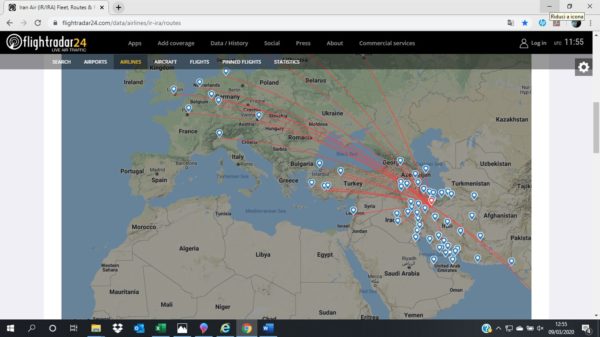
 Speciale per Africa ExPress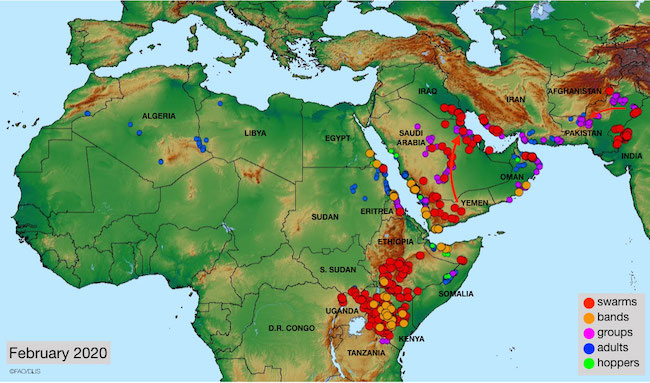
 @sand_pin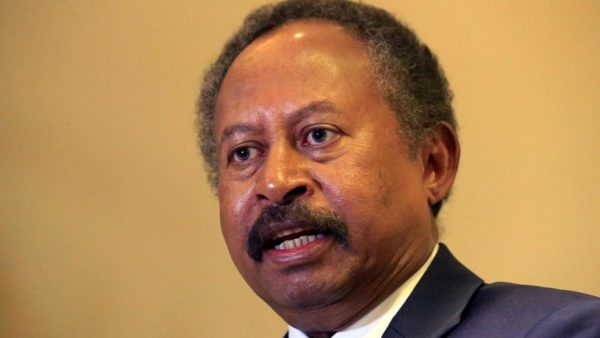
 Africa ExPress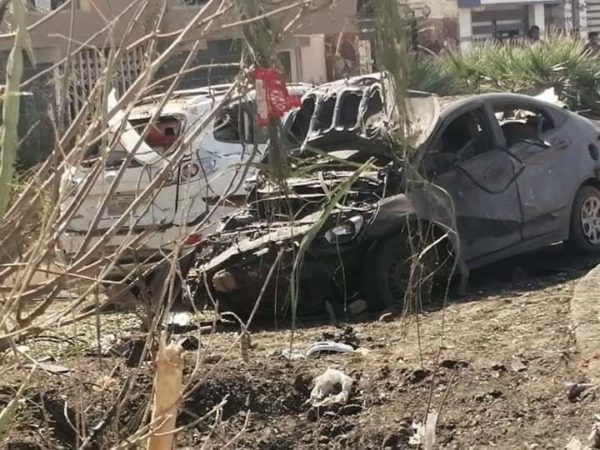

 Speciale per Africa ExPress
 Speciale per Africa ExPress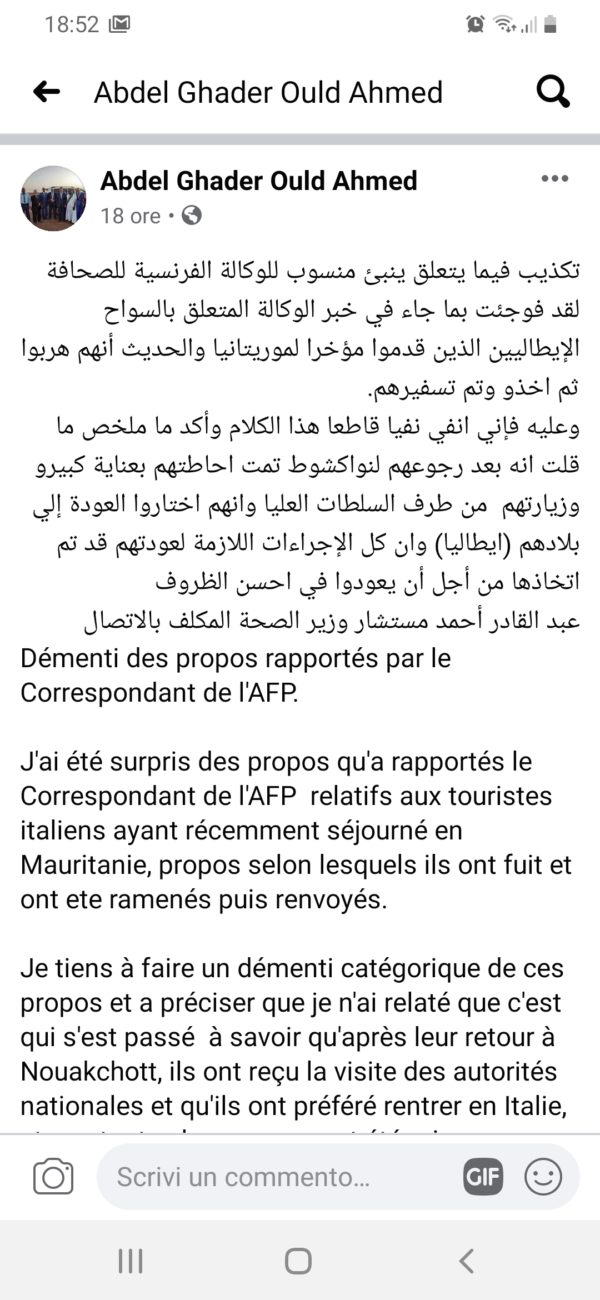
 Special for Africa ExPress