16.9 C
Nairobi
giovedì, Aprile 9, 2026

La notte infinita del Medio Oriente

Speciale per Africa ExPress Fabrizio Cassinelli 8 aprile 2026 È...

Liberata la giornalista americana Shelly Kittleson, rapita in Iraq

Africa ExPress m.a.a. (+ agenzie e New York...
Home Blog Page 479

Dossier Eritrea 1 – The Forto Incident and the Repression of the Regime

2

Our Special Correspondent
Saba Makeda
Somewhere Inside Eritrea, 4 October 2013

Took me by surprise when I found out yesterday
I heard it through the grapevine not much longer will you be mine…………………[1]

 When  the  Arab  spring  exploded  in  2011/2012  many Eritreans as well as many members of the International  community  were asking if such movement would happen in Eritrea.  Will Eritreans rebel? Will there be street marches against the regime in Eritrea?
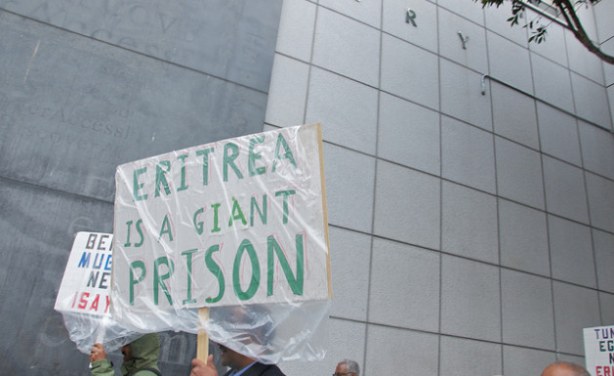
cartello giant prisonIn reality young Eritreans have been protesting for years, by refusing to report for the military service and by leaving the country, in many cases with little support. According to the UN Eritreans are now leaving the country at the rate of 7,000 people every month. UNOCHA (Ethiopia) reports that more than 200 Eritreans cross the border every day. During  the months of September  and October (2014)  over 3,450  Eritreans  have  fled into  Northern  Ethiopia taking the total of Eritrean  refugees in Ethiopia  to   104,000.

The increase in the number of Eritreans  crossing into Ethiopia is  very likely due increased hardships and tension within the country as well as the fact that  in July 2014  Sudan , in contravention  of  the  1951 Refugee  Convention and  2014 Sudanese Asylum  Act (http://www.un.org/apps/news/story.asp?NewsID=48206#)   forced Eritreans and other asylum seekers to return to their countries.

In  Eritrea the  Arab  Spring inspired civil  disobedience strengthening the  “Enough “ campaign that  started in 2004/2005 and  evolved into the Arbi Harnet (Freedom Friday ) campaign.  The Freedom Friday campaign links the diaspora based resistance to the in country resistance to the dictatorship in Eritrea. The Freedom Friday campaign calls all Eritreans to wake up to their rights and specifically to register their protest by civil disobedience and by removing their presence from public spaces such as city and town squares especially on Fridays. The  campaign has overcome  the fact that there is no independent media within  Eritrea  by  adopting  multiple  strategies including: phone  campaigns; distributing poster often disguised as a  notices, using the Eritrean  grapevine .

On  21  January  2013  approximately 100 mutineers took  control of the Ministry of Information located  Forte Baldissera  an Italian Fort also  known as known as  Forto. Eritrean Television (Eri TV) broadcasts from the Forto.  The mutineers forced the head of   the state owned Eri – TV Mr Asmelash Abraha   to read a communique “on air”. However no sooner had Mr Asmelash started reading that Eri TV signal was cut.

2954_nokia_campaignThe communique called for: (1) the implementation of the 1997 constitution, which has been suspended since 1998-2000 war against Ethiopia, (2) the release of political prisoners as well as  (3) the release of those who were arrested while trying to flee the country.[2]

The Forto incident became the focus of Arbi Harnet campaign as well the focus of protests by Eritrean organisations throughout the diaspora against President Isaias’s Regime. It was not enough the mutineers lead by Col Saleh Osman and two majors were arrested. Col Saleh Osman was not only a hero of the Eritrean Liberation Movement he was also responsible for the defence of the port of Assab during the Eritrea/Ethiopia war 1998-2000.

Soon after the Forto incident, a military Disciplinary Committee was established. The Disciplinary Committee was headed by General Manjus and Brigadier General Eyob Fessahay “Halibay” as the person in charge of coordination with the Office of the President. General Manjus has been implicated by the UN Somalia Eritrea Monitoring Group (S/2011/433 and S/2012/545) as the key figure in Eritrea’s weapons and human smuggling operations
sbarreThe Disciplinary Committee initiated a purge campaign resulting in the arrest of at least 800 people (http://webtv.un.org/search/sheila-b.-keetharuth-third-committee-32nd-meeting-69th-general-assembly/3864949861001?term=eritrea). Among the arrested:

  • Mr Ahmed  Haj Ali Minister of Mines and Energy
  • Mr Mustapha Nurhussein – Governor  of  Zoba  Debub  (Southern Zone)
  • Mr Abdalla Jabar – Director of Organisational  Affairs for the People’s  Front  for Democracy and Justice  (PFDJ) the ruling  party
  • Mr Sulleiman Haj – Major of  Mendefera city ( Zoba  Debub –  Southern Zone )

The indirect information available on the four Government officials is that Mr Mustapha Nurrhussein is dead (Eritrean websites, other personal communications), Mr Ahmend Haj Ali was released only to be rearrested. Mr Ahmed has been replaced as Minister of Mines and Energy by General Sebat Ephrem the former Minister of Defence. No information is available on the fate of Mr Abdalla Jabar, or Mr Sulleiman Haj. There is also no information as to the whereabouts of the Forto mutineers the exception is Col Osman Saleh who is reported as having committed suicide (Eritrea Somalia monitoring report 2013)
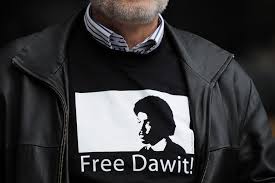
free DawitAs at the date  of writing this  article  I was not able to  positively ascertain who is  the present Minister of  Defence it is possible that  Major General  Philipos Woldeyohannes ,the chief  of  staff, is  acting  in this  capacity. Adding to the uncertainty are reports that President Isaias is in the process of restructuring the army. The role that the Tigray People’s Democratic Movement (TPDM) also known as “Demhit” is likely to have in such restructure is cause for concern.

Since October 2013, “Demhit” has featured prominently in the internal affairs of Eritrea. Members of Demhit are from the same group as the President and in the current climate are seen to be personally loyal to the President.  The militia is functioning not only as an opposition group to Ethiopia but also as protector of President Isaias Afewerki’s regime.

Saba Makeda
makedasaba@ymail.com
(1 – comtinua)

[1] I heard it through the grapevine – Creedence Clearwater Revival
[2] Radio  Erena, established in  2009  by  a group of Eritrean  exile journalist, with the support of  Reporters without Borders was the first  radio  station to report the incident as it was unfolding

Here you can read the second article on the dossier Eritrea
The Dictator is in Crisis. Dissidents and Defections Increasing
 

Central African peacekeeping force gears up for action

IRIN
Loango, Southern Congo, 10 November 2014

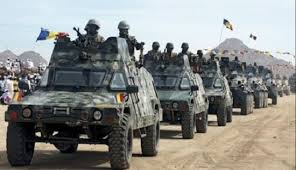
With hundreds of soldiers from its member states successfully completing a series of joint exercises and manoeuvres in Congo, the Economic Community of Central African States (CEEAC) says its Multinational Force for Central Africa (FOMAC), is now ready to intervene in local conflicts and be part of global anti-terrorism initiatives.

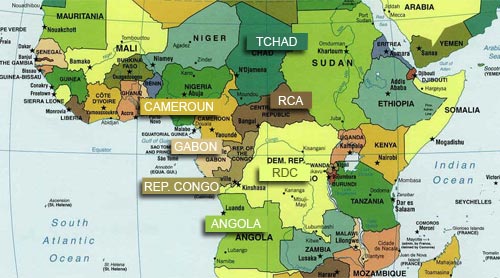
CEEAC blidatiThe recently completed Loango 2014 operations brought troops from eight of CEEAC’s 10 member countries (Angola, Burundi, Cameroon, CAR, Chad, Congo, Democratic Republic of Congo, Equatorial Guinea, Gabon, and Sao Tome et Principe – Rwanda may rejoin) to Loango in the south of Congo.

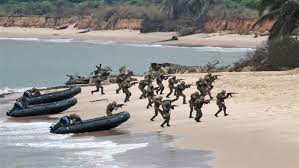
During 10 days of intense exercises, Congolese, Angolan and Cameroonian soldiers disembarked from a vessel supplied by Equatorial Guinea. On land, they constructed a field hospital and staged simulated exercises in which hostages were liberated and a rebel leader was captured and removed to a safe location.

The operations involved both ordinary soldiers and more specialist parachute units. In overall command was Congolese Chief of Staff Gen Blanchard Guy Okoï.  Presidents Denis Sassou of Congo, Ali Bongo Ondimba of Gabon and Obiang Nguema of Equatorial Guinea were among the guests at a closing ceremony on 29 October.

sbarco in spiaggiaAhmad Allam-Mi, a former Chadian foreign minister, now CEEAC’s secretary-general, said the organization had shown how quickly it could respond to human needs in time of crisis. “Our force is capable of bringing help to the population,” Allam-Mi emphasized.   There was a strong emphasis in Loango on fighting terrorism in central Africa. Gabon Defence Minister Ernest Mpouho Epigat pointed to the challenges posed by maritime piracy, but also warned that the Nigerian Islamist movement Boko Haram was in striking distance of central African nations. “Cameroon is now on the frontline,” Epigat warned. “It is good that the countries of the sub-region hold this kind of exercise to see how we can pool our personnel and resources to respond to these threats and push them as far away as we can.”

A BIT OF HISTORY

Until recently, CEEAC was seen as slow to develop a serious military profile. Formed in 1983, it was virtually moribund for much of the 1990s, falling victim to regional rivalries and having a lack of shared priorities. Geographically, it seems an incongruous grouping of nations, stretching from Sao Tomé and Principe in the Atlantic to Chad.

soldati congoCEEAC used an extraordinary summit in Libreville (Gabon) in February 1998 to put itself on a new footing. At a subsequent meeting in Malabo (Equatorial Guinea) in 1999, heads of state outlined the need to work more closely on peace and security issues.

Tracing CEEAC’s history, security analyst Angela Meyer observed in Peace and Security Cooperation in Central Africa: Challenges and Prospects: “The lessons from years of conflict and crises made it clear that regional economic cooperation could not succeed without regional peace and security.” [ https://www.google.com/webhp?sourceid=chrome-instant&ion=1&espv=2&ie=UTF-8#q=Angela%20meyer%20Challenges%20Central%20Africa ]

Progress was initially slow. Member states were bitterly divided over the conflict in the Democratic Republic of Congo, which broke out in 1998. Chad and Angola sent troops to defend embattled President Laurent Kabila; Rwanda and Burundi backed rebels advancing on Kinshasa.

STRONGER REGIONAL FRAMEWORK TAKES SHAPE

But a stronger regional security framework did take shape. The Council of Peace and Security of Central Africa (COPAX), operational since 2004, was set up to guide regional policy on defence and security and given a mandate not only to deploy civilian and military missions, but to help mediate in crises.  

parataThe Commission of Defence and Security, made up of military and police chiefs, works under a regional Planning Element and military headquarters, based in Libreville. CEEAC has at its disposal a Strategic Analysis Group (GAS) and a Rapid Alert Mechanism for Central Africa, operating as an early warning system. Pointe Noire in Congo hosts a Regional Centre for Maritime Security.

The collective security initiatives taken in Central Africa are in line with priorities outlined for the African Union’s (AU) African Peace and Security Architecture (APSA), which stresses the need for viable regional structures that replicate what the AU is doing at continental level. For example, the AU wants to see regional versions of its Peace and Security Council (PSC) and its Continental Early Warning System, which CEEAC’s MARAC seeks to emulate.

Critical to the AU’s long-term security plans is the African Standby Force (ASF), which has the right to intervene in a member state “in grave circumstances, namely war crimes, genocide and crimes against humanity”. The ASF’s viability is premised on efficient standby arrangements with Africa’s five sub-regions, which should “enable Africans to respond swiftly to a crisis unhampered by any heavy political and instrumental burden.”

In principle, each regional bloc now has its own contingent earmarked for ASF deployments, with FOMAC joining parallel forces in other parts of the continent. An AU review of APSA’s progress in 2010 acknowledged serious problems with each region in delivering on commitments, pointing to ongoing conflicts and a lack of operational capacity as major handicaps.

FOMAC – A FORCE IN PROGRESS

FOMAC was not singled out for criticism, but clearly needed to become more professional and better coordinated.

parata 2Set up in 2002, FOMAC’s standing orders identified the force as being made up of military, police, gendarmerie and civilian personnel, ready to carry out “peace, security and humanitarian assistance missions”. FOMAC’s duties also extend to disarmament and demobilization work and control of fraud and organizational crimes.

Compared to the experience gained by Economic Community of West African States (ECOWAS) troops in West African conflicts, including Liberia, Sierra Leone and Guinea-Bissau, Central African soldiers saw little combat in regional missions, but no shortage of capacity-building and practical collaboration.

Loango 14, which was months in the planning, was the latest in a series of multinational training events, going back nearly a decade, which have become increasing ambitious in their scale and objectives. Chad played host to the Barh el Ghazel exercises in 2005 and 2007. Over 3,500 personnel took part in Kwanza 2010 in Angola.
FILLING A VACUUM IN CAR

It was the succession of crises in CAR which gave Central African troops their first exposure to a regional war zone. FOMUC, the multinational force of the six-nation Economic and Monetary Community of Central Africa (CEMAC), was stationed in Bangui with a brief to support the CAR Armed Forces, which had been hit by a wave of mutinies, threatening the rule of President Ange-Félix Patassé. (CEMAC members are: Gabon, Cameroon, CAR, Chad, Congo and Equatorial Guinea).

MAPPAFOMUC was superseded in 2008 by the Mission of Consolidation of Peace in CAR (MICOPAX – a specific mission of FOMAC). Funded in part by the EU and working closely with French troops, its mandate was to help establish peace and security.

After a long period of low-intensity guerrilla activity and hesitant peacebuilding, MICOPAX was hinting at a withdrawal by September 2012. A Chadian commander told Radio France Internationale (RFI): “Elections have been held and we are now in a phase of consolidating the peace.”

But the emergence of Séléka, a newly formed, heavily armed rebel coalition ended that complacency. As Séléka made critical territorial gains from December 2012, CEEAC called for more troops, but could not prevent the fall of Bangui.

Blanchard Guy Okoï.As CEEAC tried, with difficulty, to drive the peace process outside CAR, MICOPAX numbers tripled, with over 2,000 troops deployed. MICOPAX 2’s brief was ambitious: to guarantee security, provide protection and help restore police and judicial system. The leading contributors were Congo, Burundi, Chad and Rwanda, although Rwanda had left CEEAC in 2007.

Often overshadowed by the French military presence, FOMAC again faced accusations of poor leadership and incoherence and having little real presence outside Bangui.  FOMAC’s Chadian contingent was accused of aligning itself with the Séléka rebels, a charge strongly denied by the Chadian authorities.

In December 2013, after lengthy talks between the AU and CEEAC, peacekeeping operations were formally transferred to the African-led International Support Mission to the Central African Republic (MISCA), which in turn transferred authority to the UN Multidimensional Integrated Stabilization Mission in CAR (MINUSCA) in September 2014.

Troops from CEMAC
countries still make up the vast majority of troops deployed in the CAR.

THE VERDICT ON MICOPAX

FOMAC’s role in the country has been much criticised. But Alex Vines, head of the Africa programme at the Royal Institute of International Affairs (Chatham House), said FOMAC soldiers had endeavoured to protect the civilian population, perhaps more effectively than other outside forces. “It was not a particularly exemplary operation”, Vines told IRIN. “But the troops were there in very difficult circumstances.”

Sassu NguessuVines, who has authored a 10-year study of the AU’s approach to continental security, A Decade of African Peace and Security, Architecture, said all of the regional forces meant to contribute to the ASF fell short of the AU’s requirements. He noted the lack of a regional leader, the role played (controversially) by Nigeria in West Africa in the past, and also of states, like Angola, having a stake in different regional blocs.

RWANDA RE-JOINS THE FOLD

Rwanda pulled out of CEEAC in 2007, pleading insufficient funds, and engagements in too many other regional blocs, the East Africa Community (EAC), for example. The deployment of Rwanda troops in the CAR as part of MICOPAX suggested that Rwanda was ready to re-engage with CEEAC. This was confirmed by Rwandan Foreign Minister Louise Mushikiwab at Loanga, who said her country had come a long way from the genocide of 1994 and wanted to play a full role in CEEAC. “We have decided to rejoin our brothers and sisters in Central Africa with whom we share an important heritage,” Mushikiwabo explained. “At the next of its summits, we will reintegrate with CEEAC. With great pleasure we will come back into the heart of the family.”

IRIN
IRIN, the humanitarian news and analysis service
of the UN Office for the Coordination of Humanitarian Affairs.
The opinions expressed do not necessarily reflect those
of the United Nations or its Member States.

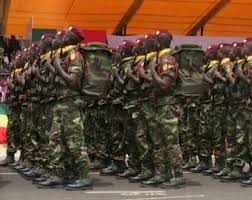
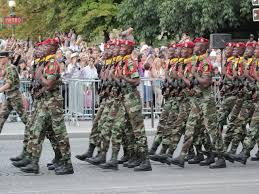
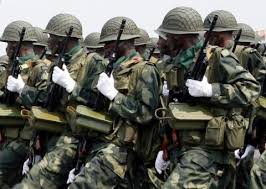
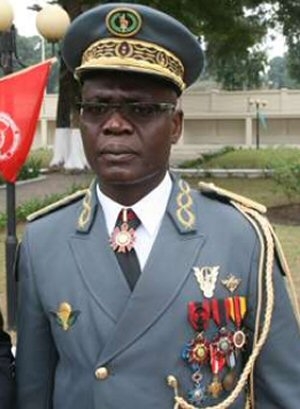
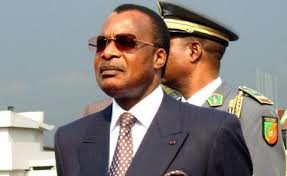
In the pictures General Blanchard Guy Okoï end .presidents Denis Sassou of Congo

Uccise in un agguato due donne insegnanti a Mogadiscio

0

Africa ExPress
Mogadiscio, 3 novembre 2014

Due donne, insegnanti di scuola elementare, sono state uccise ieri a Mogadiscio in un agguato tesogli da due uomini armati che le hanno attese fuori dal piccolo istituto dove avevano appena finito le lezioni. La notizia è riportata dal sito somalo Maareg.

Appena sono comparse instrada le due maestre sono state freddate a colpi di pistola. I due assassini si sono immediatamente dati alla fuga. L’omicidio è avvenuto nel distretto di  Dharkeynley, il cui capo, Adam Mohamed Omar, ha promesso che sarà lanciata una caccia all’uomo per individuare e catturare i killer. Ovviamente non si conoscono i motivi del massacro, ma è facile immaginare che i mandanti siano da ricercarsi tra gli shebab, gli islamici che combattono il governo somalo sostenuto dalle Nazioni Unite.

Africa ExPress

Central African Republic: The search for justice

IRIN
Bangui, October 31st 2014

As the International Criminal Court (ICC) steps up its work in the Central African Republic (CAR), pledging to bring the worst perpetrators of violence to justice, concerted efforts are being made to counter endemic impunity in CAR. But the prevailing insecurity in many parts of the country rules out any quick fix solutions.

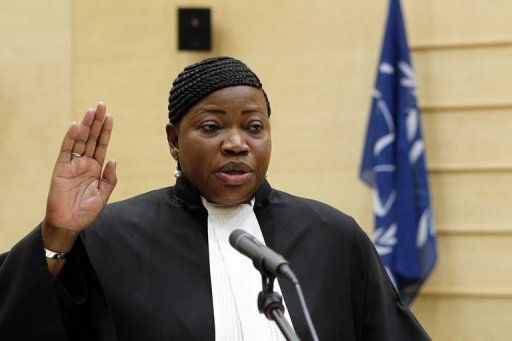
la-gambienne-fatou-bensouda-prete-serment-pour-devenir-la-no_721988ICC Prosecutor Fatou Bensouda (picture to the left)  announced in September that the ICC was ready to open its second investigation in CAR. According to Bensouda, a preliminary enquiry in February had “gathered and scrupulously analysed relevant information from multiple sources”, leaving no doubt as to the ICC’s right to intervene under the Statute of Rome. “The list of atrocities is endless,” Bensouda emphasized. “I cannot ignore these alleged crimes.”

The preliminaries may be out of the way now and the ICC set for a full investigation, but there has been no indication from The Hague as to how long it will take before suspects are identified, warrants issued and defendants brought to trial.

SELEKA AND THE ANTI-BELAKA BOTH WANTED FOR WAR CRIMES

A report by the Office of the Prosecutor for the ICC on 24 September provides a detailed account of CAR’s descent into civil war from August 2012 and the role played by both the Séléka insurgents and the anti-Balaka militias which tried to counter the rebellion.

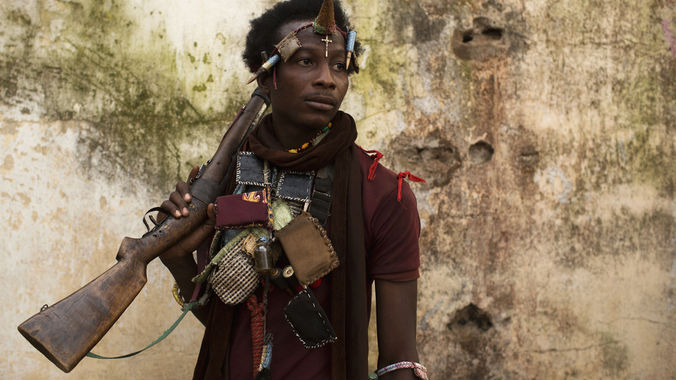
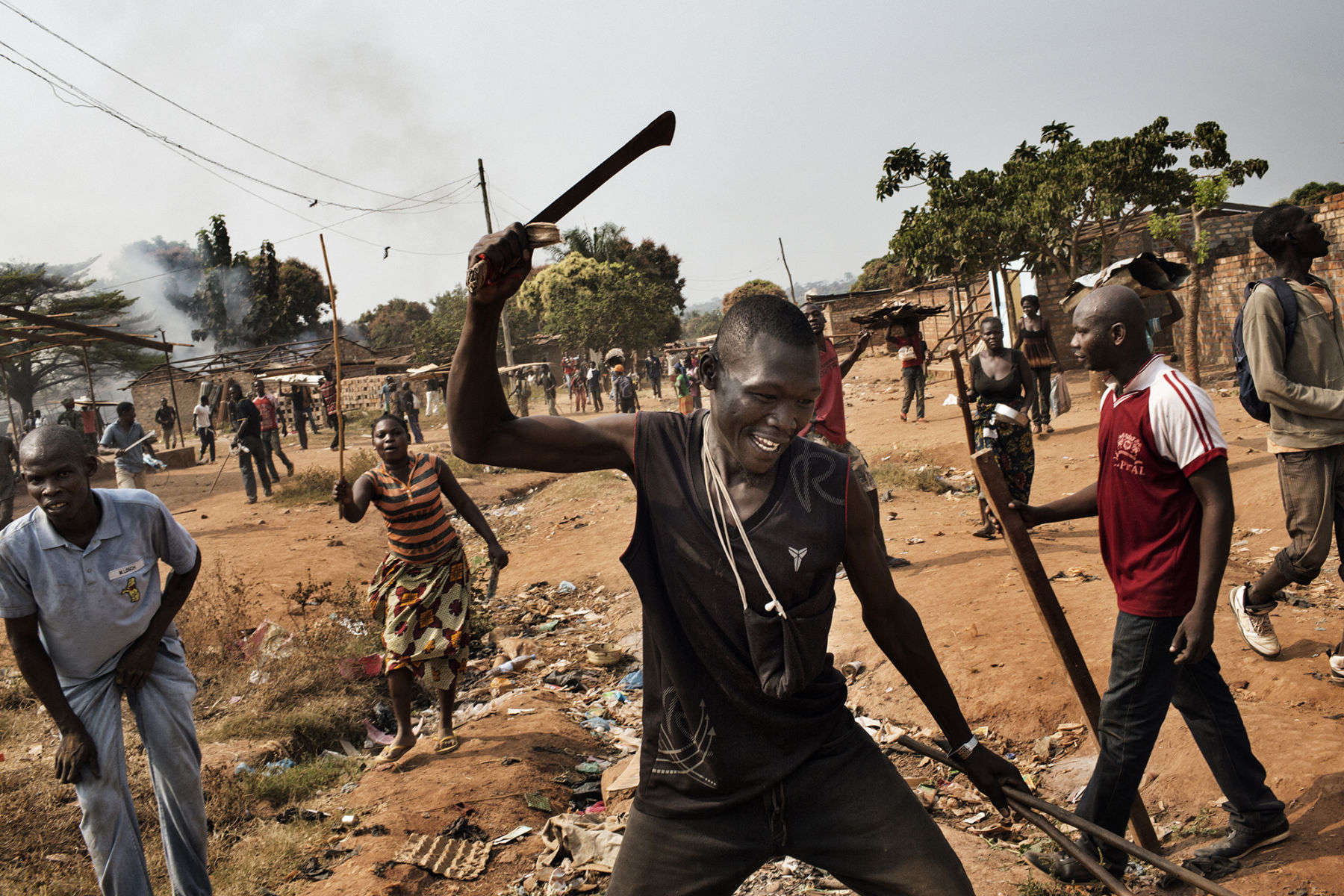
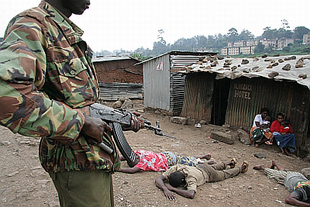
atrocità in carThe ICC describes a period of persecutions and pogroms in which ordinary citizens were routinely targeted on grounds of their ethnicity and religion. The document echoes earlier reports from organizations like Human Rights Watch (HRW) and the International Federation of Human Rights (FIDH) and testimonies from CAR human rights activists. Bensouda herself accuses Séléka and anti-Balaka fighters of engaging in “crimes against humanity and war crimes, including murder, rape, forced displacement, persecution, pillaging, attacks against humanitarian missions and the use of children under 15 in combat.”

UN COMMISSION APPEALS FOR CHRISTIAN-MUSLIM DIALOGUE

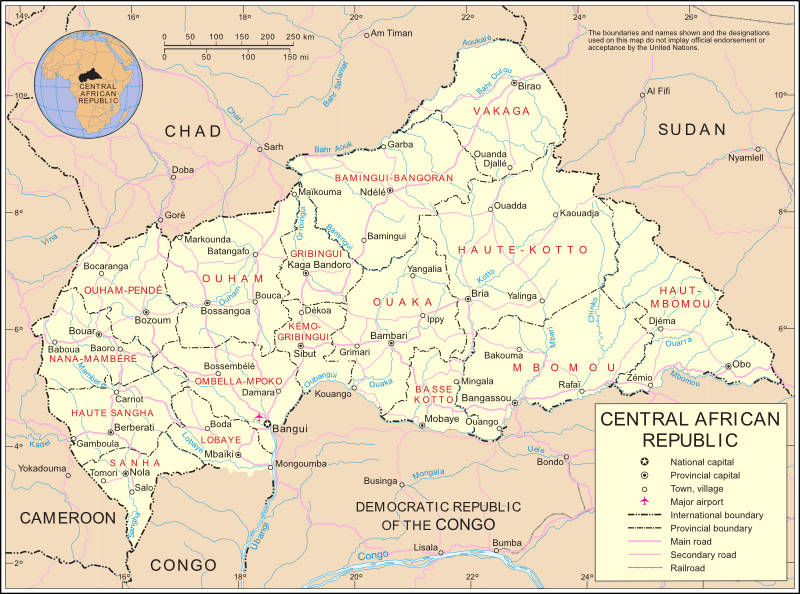
The UN’s own International Commission of Inquiry into Human Rights Violations in CAR, set up by UN Mappa politicaSecurity Council Resolution 2127 in December 2013, draws similar conclusions. After a first visit to CAR in March 2014 and follow-up research in April and May, the Commission submitted its preliminary report in June. It highlighted the prevalence of extra-judicial executions, enforced disappearances, torture and arbitrary arrest and detention.

Commission President Bernard Muna from Cameroon, formerly deputy prosecutor of the International Criminal Tribunal for Rwanda (ICTR), warned of “hate speech” stoking tensions and called for urgent dialogue between Muslims and Christians.

TENSIONS AND TERROR FOR THE LEGAL PROFESSION

The ICC has the clear backing of the government of interim President Catherine Samba Panza. In a 30 May communiqué, referring the situation in CAR to the ICC, Samba Panza’s government spoke of “multiple cases of crimes against humanity and other odious violations of human rights perpetrated since 2012”.

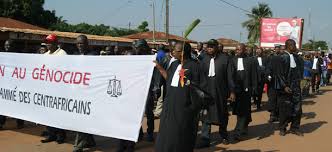
After the SelekaWhile the ICC’s work gathers momentum, human rights campaigners and legal experts have repeatedly drawn attention to glaring deficiencies in CAR’s domestic justice system.  Magistrates were given pay increases when Michel Djotodia took power in March 2013.

As with other parts of the administration, however, the justice system operates well below normal capacity, confronting enormous difficulties. The lack of basic resources is an inconvenience. More telling are the risks run every day by magistrates and others. “If magistrates try to do their job properly, they and their families are targeted,” an assistant prosecutor told IRIN. “At the moment, our priority is saving our own lives.”

“Even in the court rooms there is no guarantee of security,” an official at the ministry of justice complained. “The relations of those facing charges will often come to court to exert pressure.”   Several of those detained have escaped from prison and rejoined the ranks of different armed groups. With CAR police and military structures unable to function properly, soldiers from the French-led Operation Sangaris have arrested fighters from Anti-Balaka militias. But one of Anti-Balaka’s main leaders, Patrice-Édouard Ngaïssona, was subsequently released by the authorities.

Visiting Bangui in April 2014, then UN High Commissioner for Human Rights Navi Pillay warned that CAR was marked by “total impunity, no justice, no law and order apart from that provided by foreign troops”.

THE NEED FOR HOMEGROWN JUSTICE

Pillay called for major legal reforms and the creation of a National Human Rights Commission, but warned: “Creating an effective justice system, prisons, police forces and other key State institutions, virtually from scratch, is a massive and complex enterprise that cannot be done on the cheap.”

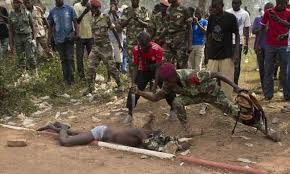
Soldato e mortiIn its July 2014 report, Central African Republic: Time for Accountability, Amnesty International criticized the international community’s hesitant approach to CAR’s justice and human rights challenges.

Amnesty stressed the need for CAR to take a bigger role in administering justice, or face the consequences. “If CAR does not institute its own investigations and prosecutions, many perpetrators of crime under international law will continue to enjoy impunity for their crimes.”

A SPECIAL CRIMINAL COURT FOR BANGUI 

Amnesty’s recommendations included the creation of a “hybrid” tribunal, comprising both CAR citizens and internationals, arguing that such a body could help build the confidence and credibility of the national justice sector.   CAR appears to be heading in this direction. In August, the government and the UN Mission in CAR (MINUSCA) signed an agreement on the formation of a Special Court, composed of CAR magistrates and legal experts from outside.
While the ICC will seek to prosecute the most serious offenders in CAR, the Special Court will tackle violations of human rights and breaches of international humanitarian law, including acts of sexual violence and violations of children’s rights.

The court’s foundation will depend on the passing of a law by CAR’s interim parliament, the National Transitional Council (TNC). According to Justice Ministry sources contacted by IRIN, such a law should be in place by the end of 2014.

ENQUIRIES UNIT READY TO DIG DEEPER 

In April 2014, the government announced the creation of the Special Unit of Inquiries and Instructions (CSEI). Working under the supervision of the prosecutor-general of the Court of Appeal, the Unit’s brief goes well beyond the recent conflict, covering the period from 1 January 2004, nine months into the 10-year rule of François Bozizé.

demoThis shows a concern for balance, with the abuses investigated not confined to just one administration. The “serious crimes” to be examined include crimes against humanity, war crimes and crimes of aggression.

According to the decree which established it, CSEI is composed of both legal personnel, including judges and prosecutors, along with 20 judicial police officers from the Gendarmerie and the national police. Although welcomed by legal experts and human rights campaigners, there are already concerns about CSEI’s lack of resources and its capacity to carry out in-depth investigations, particularly outside Bangui.

There were similar reservations about the Mixed Commission of Inquiry set up in May 2013 under the short-lived administration of Michel Djotodia. Headed by senior CAR magistrate Flammarion Gaba, the Commission also gave a prominent role to Mathias Moruba, president of the Observatory of Human Rights (ODH). Other members were drawn from the gendarmerie and military.

Although the Commission reportedly received dozens of complaints and requests for damages from victims of human rights violations and other crimes, there have been questions asked about its overall effectiveness. The Commission appears to be no longer operating.

CONVINCING THE SCEPTICS

The ICC’s professed determination to pursue war criminals and the creation of new institutions within CAR has not convinced everyone.   This is the second time ICC has been involved in CAR. In 2004, the Bozizé government requested ICC intervention against Congolese politician and former rebel leader Jean-Pierre Bemba, alleging widespread human rights violations committed by troops from Bemba’s Movement for the Liberation of Congo (MLC) in 2002 and 2003 after their recruitment by then President Ange-Félix Patassé.

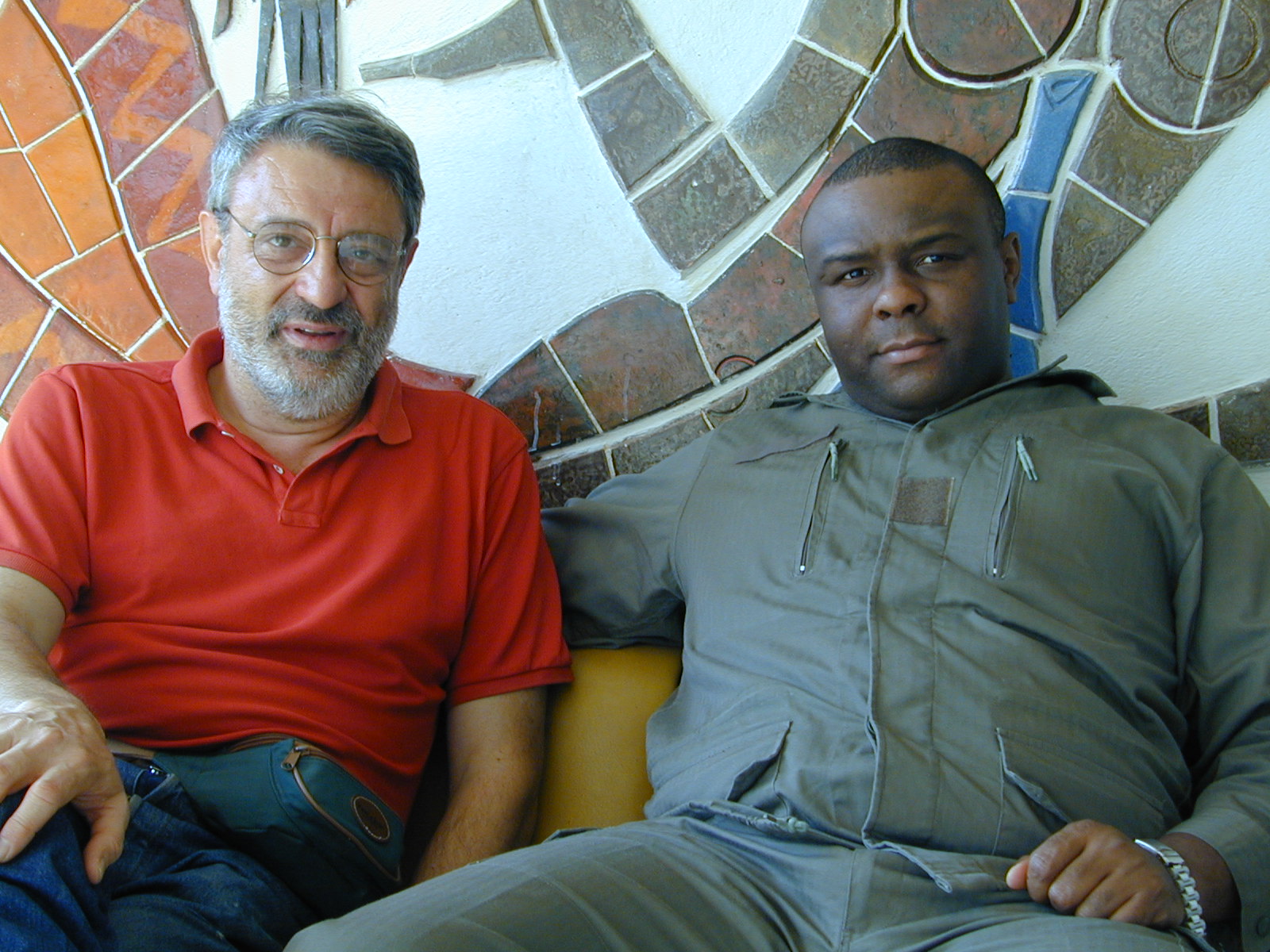
Io e BembaBemba was arrested in Belgium in May 2008 and faces two counts of crimes against humanity and three counts of war crimes. The trial started in November 2010. According to the ICC, closing oral statements are due in November 2014.  Benjamin Grekoy, a small businessman, told IRIN he was baffled by the delays. “It is years now since Bemba was arrested and his trial is still not over. Why? When is he going to be judged?”  Grekoy was also sceptical about the government’s commitment to investigate past human rights abuses. “From the time of Bozizé, going on through Djotodia and today with Madame Samba Panza brought us a lot of enquiries, but without any real results,” Grekoy complained.

“It is up to Centrafricans to put down their weapons and stop killing each other. Otherwise we are stuck with enquiries that lead nowhere.”  But Joseph Bindoumi, president of the CAR League of Human Rights (LCDH) is more positive.  “At our level here at LCDH, we think these initiatives are welcome because justice is the most effective weapon in conflict situations,” Bindoumi told IRIN.

“Each time there is action from the international justice system, the ICC for example, we human rights campaigners should feel encouraged because we know the aim of all this is to halt the actions of criminals. To finish the war, there has to be the threat of punishment. I know all this takes time, but Centrafricans must be patient. They must keep the hope that one day those who have carried out serious human rights abuses must be made accountable for their actions.”

IRIN
The humanitarian news and analysis service
of the UN  Office  for the coordination of Humanitarian Affairs.
The opinion expressed do not necessarily reflect those
of the United Nations or its Member States

The last picture taken in January 2000 shows Mr Bemba with the editor of Africa ExPress, Massimo Alberizzi, in Gbadolite (Congo-K, at that time Zaire)   

Burkina Faso: Campaoré fugge in Costa d’Avorio, ma il nuovo leader non piace alla piazza

1

Nostro Servizio Particolare
Cornelia I. Toelgyes
Quartu Sant’Elena, 31 ottobre 2014

Blaise Campaoré, fino a poche ore fa presidente de Burkina Faso, dopo 27 anni di potere,  si è dimesso ed è scappato a Yamoussoukro in Ghana. Il capo di Stato maggiore, Honoré Traoré, si è auto-proclamato nuovo leader del Paese.

ragazziniMa pare che il popolo del Burkina Faso preferisca un’altra persona come presidente. Si tratta di un generale ormai in pensione. Il suo nome, Kouamé Lougué è stato scandito ad alta voce più volte ieri nella Place Nationale di Ougadugou, la capitale del Bourkina Faso.

Sempre nella stessa Place Nationale, il portavoce dell’esercito, il tenete colonnello  Yakouba Zida, ha proclamato la fine dell’era Compaoré e la sospensione della Costituzione. Ha comunicato la chiusura delle frontiere, ordinato il coprifuoco dalle 19.00 alle 6.00 e chiesto ai segretari generali dei ministeri di prendere le disposizioni necessarie per dare continuità agli affari di Stato. Yakouba è il terzo uomo che potrebbe aspirare al comando del Burkina Faso.

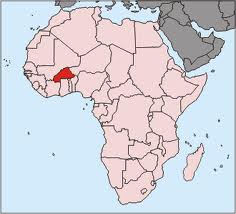
Mappa africaSecondo Pierre Engelbert, professore per le politiche africane all’università di Pomona (USA), Traoré è un uomo di potere. “Non è sicuro che abbia a cuore il programma e dell’opposizione”, ha dichiarato ai reporter di France 24. Ora il Burkina Faso, il nome vuol dire “Paese degli uomini onesti”, è in mano a tre ufficiali.

“Secondo l’articolo 43 della Costituzione – spiega Abdoulaye Soma, presidente della società di diritto costituzionale del Burkina Faso – al momento delle dimissioni del presidente in carica, il Consiglio costituzionale avrebbe dovuto essere convocato per dichiarare vacante il posto del presidente e l’interim avrebbe  dovuto essere assicurato  dal presidente dell’Assemblea nazionale. Ovviamente il Consiglio costituzionale avrebbe dovuto essere convocato dal governo, ma da ieri anche quest’ultimo è stato dissolto. Secondo l’articolo 157 della Costituzione, il Consiglio costituente può auto-convocarsi in casi del genere e se stabilisce che il potere è vacante, normalmente è presidente dell’Assemblea nazionale ad esercitarlo ad interim. Ma anche l’Assemblea è stata sciolta il 30 ottobre. In questo caso il presidente del consiglio costituente può trovare una soluzione, chiedendo alla società di trovare una o un collegio  di persone che presti giuramento davanti a lui per governare ad interim”.

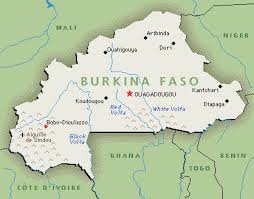
MappaEd ecco tre alti ufficiali dell’esercito: Traoré, Lougué e Zida. Ora si aspetta di capire chi di loro condurrà il Paese verso le prossime elezioni. Non si esclude la costituzione di un comitato dove ci saranno tutti e tre.

Cornelia I. Toelgyes
corneliacit@hotmail.it
twitter: @cotoelgyes

Somali pirates released Indian hostages after 4 years of captivity

Special for Africa Express
Andrew Mwangura
Mombasa, 1st November 2014

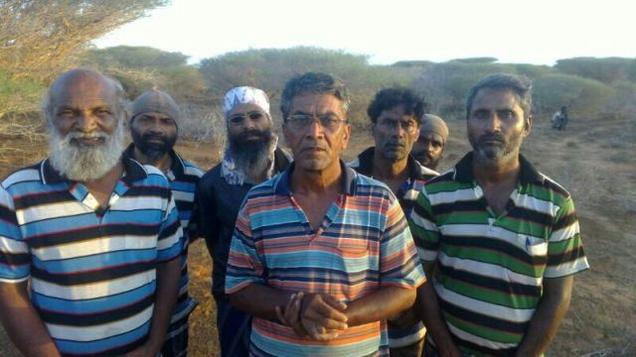
Seven Indian Seafarers who have been held hostage since their ship, the MV Asphalt Venture, was hijacked in the Somali basin on 28 September 2010, have been released and are safe in Kenya.

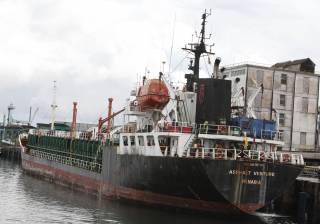
The 1991-built, Panamanian flagged , 3884 dwt., general cargo ship “MV Asphalt Venture”, with a crew of 15 was hijacked by Somali pirates off Dar es Salaam while under way from Mombasa to Durban Natal, South Africa. In April 2011 the vessel with 8 of her crew was released, following a ransom payment amounting to US dollars 3.5 milion, while the remaining 7 Indian seafarers were detained ashore.

Asphalt_VentureFollowing lengthy negotiations, the release of these men was arranged after a modest payment was made “to cover the logistical and transport costs” of the group holding the men. Preparations are now being made for their return to India in the next few days. Their families have been informed.

Last July a pirate leader is said to have been seriously injured while one gunman is said to have died during a heavy exchange of gun fire amongst gunmen holding captive seven Indian crew members.

Reports filtering Mombasa mid-last July indicated that fighting erupted amongst pirates holding captive the crew members soon after ransom money amounting to US dollars 500,000 was delivered to the gunmen to secure safe release of the hostages. Initially the pirates holding captive the seven former crew members of the ship were demanding 1 million US dollars to release the hostages.

The hostages were held captive in a remote village known as FAA some 20 kilometers from Harardheere. They were kept hostage by a pirate group under the leadership of Fathi Gacamey.

Crew of Asphalt VentureDespite the owner’s concluding a dialogue with the pirates for the full release of 15 crew and vessel and payment of the ransom, the vessel was released but 6 officers and 1 rating were taken off the tanker and made to accompany the pirates ashore.

Media reports suggested that pirates in Harardheere have taken the decision not to honor the agreement made but to prolong the hostage ordeal of the 7 seafarers in retaliation for the arrest of Somali pirates by the Indian Navy. There are about 105 suspected Somali pirates arrested by Indian navy undergoing trial in the courts of law of India.

Thirty seafarers and fishers are still held hostage by Somali pirates, some for more than four and a half years and the others for more than two and half years.

 Andrew Mwangura
Secretary General

Seafarers Union of Kenya
www.piracyreport.com

In the picture: top the ship Asphalt Venture and down the seven captive crew members (From left to right): T.B. Unnikrishnan, George Joseph, Sohan Singh, Bahadur Singh, Bhim Singh, Daniston, Manjit Singh) pictured in a January 2013  from an undisclosed location in Somalia. 

Dissolto il governo, sciolto il parlamento in Burkina Faso, Compaoré rinuncia al terzo mandato

Nostro Servizio  Particolare
Cornelia I. Toelgyes
Quartu Sant’Elena, 31 ottobre 2014

Sciolto il parlamento, sciolto in governo in Burkina Faso, dopo le violente proteste di piazza dei giorni scorsi. L’annuncio è stato dato in televisione ieri dal capo di Stato maggiore, generale Honoré Traoré. Un organo di transizione, che sta per essere costituito, governerà il Paese per al massimo 12 mesi per riportare l’ordine costituzionale. Il presidente Blaise Compaoré ha annunciato che sarà ritirato il progetto di emendamento della Costituzione che prevedeva un terzo mandato per il capo dello Stato e se ne andrà nel novembre 2015 come previsto.

IncendioNel Paese è in vigore il coprifuoco in tutto il territorio nazionale dalle 19.00 alle 06.00 per proteggere le persone e i beni, a partire da oggi.

Taoré ha presentato le sue condoglianze alle famiglie delle vittime decedute durante i disordini e chiede la collaborazione dei cittadini per riportare la calma e nel Paese. Ha chiesto che ognuno ritorni alle proprie occupazioni con calma e serenità.

In tarda serata è stato fatto un altro annuncio da Compaoré, che ha parlato alla popolazione dal terzo canale. “Non sono dimissionario. Voglio aprire negoziati con forze d’opposizione, sono favorevole a un governo di transizione, ma consegnerò il potere solamente ad un presidente democraticamente eletto dal popolo alla fine del mio mandato” (tra un anno, appunto).

[embedplusvideo height=”430″ width=”570″ editlink=”http://bit.ly/1DCZRDA” standard=”http://www.youtube.com/v/dGpexG6SXGw?fs=1″ vars=”ytid=dGpexG6SXGw&width=570&height=430&start=&stop=&rs=w&hd=0&autoplay=0&react=1&chapters=&notes=” id=”ep1921″ /]

Gli ultimi giorni sono stati contraddistinti da particolari violenze. Già il 28 ottobre la popolazione, militanti e simpatizzanti del partito d’opposizione sono scesi in piazza a Banfora, capoluogo della provincia di Comoé, nella Regione delle cascate, nel sud-ovest del Paese, per esprimere il loro disappunto nei confronti del presidente. Compaoré, che si è impossessato del potere nel 1987 con un colpo di Stato, ha tentato di candidarsi nuovamente alle prossime elezioni, previste per il prossimo anno, per un terzo mandato, ma l’articolo 37 della Costituzione non lo permette. Prevede un massimo di due mandati per il presidente in carica.

FumoIl 21 ottobre, durante una seduta straordinaria del consiglio dei ministri, è stato elaborato un disegno di legge, da sottoporre all’Assemblea Nazionale, per modificare il “famigerato” articolo 37. Il giorno stesso, opposizione e organizzazione della società civile hanno sollecitato la disobbedienza civile. Già alla fine di maggio durante una manifestazione pacifica allo stadio 4 agosto di Ouagadougou, la capitale del Burkina Faso, il capo dell’opposizione, Zephirin Diabre,  aveva sottolineato, parlando alla folla: “Non siamo una monarchia, dove si muore con il potere in mano”.

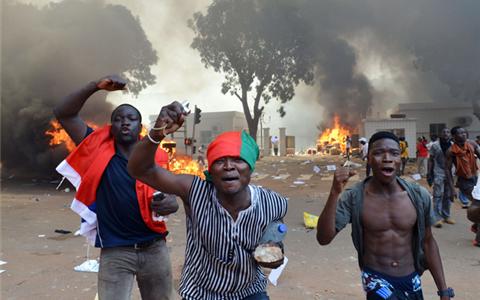
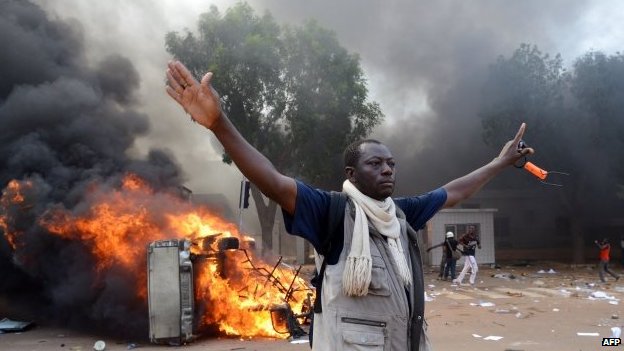
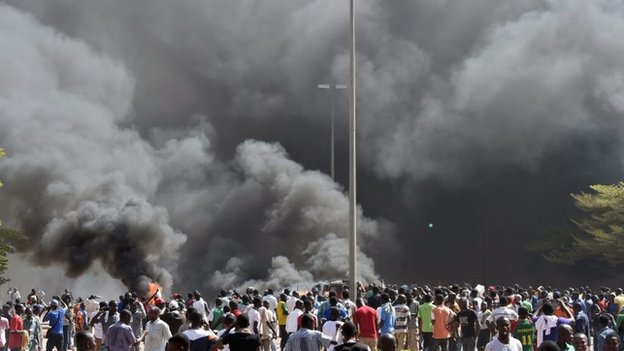
Ieri, migliaia e migliaia di persone (c’è chi dice che fossero addirittura un milione), si sono versate sulle strade della capitale. Il parlamento è stato incendiato, occupata la TV di Stato, abbattuta la statua di Compaoré. Almeno cinque persone sono morte durante gli scontri.

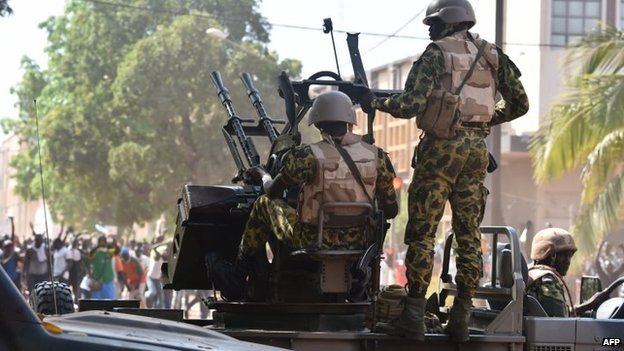
soldatiGli Stati Uniti e la Francia hanno espresso la loro preoccupazione. Qualche giorno fa François Hollande, tramite il suo ministro agli esteri Laurent Fabius in un comunicato ha ricordato al suo omologo in Burkina Faso di rispettare le regole, le leggi vigenti. Mentre il sotto-segretario di Stato USA per gli affari africani, Linda Thompson-Greenfield, ha dichiarato: “Due mandati sono più che sufficienti”.  E Obama, durante il meeting tenutosi a Washington dal 3 al 6 agosto 2014 in presenza di 50 capi di Stato africani ha ricordato: “L’Africa non ha bisogno di uomini forti, ma di Istituzioni forti”.

Anche l’Unione Europea, qualche giorno fa, ha espresso la sua preoccupazione a riguardo della situazione in Burkina Faso e ha chiesto al presidente Compaoré di rivedere la sua posizione circa l’articolo 37 della Costituzione.

Per il momento regna una grande confusione nel Paese, Malgrado il coprifuoco, alle 22.00 di ieri sera, molte persone erano ancora sulle strade, nelle piazze.

Cornelia I. Toelgyes
corneliacit@hotmail.it
twitter: @cotoelgyes

L’avvocato di Berardi in galera in Guinea E.: “La Farnesina? Non mi ha mai contattato”

Andrea Spinelli Barile
Firenze, 30 ottobre 2014

In un tardo pomeriggio di autunno c’è un continuo via vai di turisti e uomini d’affari nella hall di un hotel di lusso a Firenze: mi siedo sui divani, in attesa che il consierge chiami la persona che sono venuto ad intervistare. Si chiama Ponciano Mbomio Nvò, arriva dalla Guinea Equatoriale e di mestiere fa l’avvocato penalista, con riguardo particolare per la tutela dei diritti umani nel suo paese, “la peggior dittatura del mondo”, ripete spesso nel corso della nostra chiacchierata.

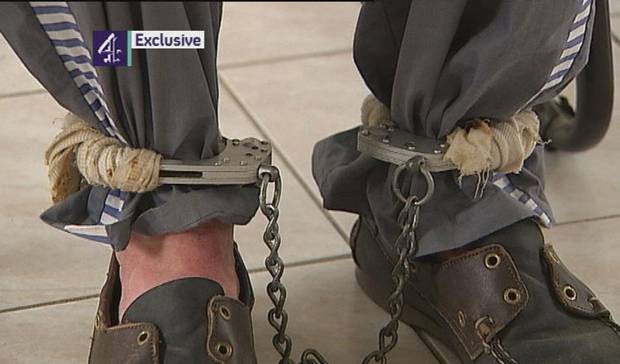
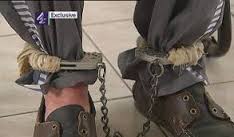
catene ai piediMbomio Nvò è l’avvocato di Roberto Berardi, l’imprenditore pontino detenuto da 22 lunghissimi mesi in una putrida cella del carcere di Bata, umiliato e vessato dai suoi carcerieri al soldo del “principe di Malabo”, il vicepresidente della Guinea Equatoriale Teodorin Obiang Nguema Mangue; da oltre un ventennio l’avvocato Mbomio Nvò combatte la sua personale battaglia per lo stato di diritto e la tutela dei diritti fondamentali dell’essere umano nel suo paese, una battaglia trascorsa sul campo dei tribunali “inquisitori” del suo paese. La sua storia comincia in carcere prima del colpo di Stato che nel 1979 ha portato al potere Teodoro Obiang Nguema Mbasogo, oggi settantaduenne.

“Migliaia di persone sono state uccise, direttamente o indirettamente, per suo ordine: l’intero Paese è amministrato dal circolo della numerosa famiglia Obiang, tutti i centri di potere appartengono agli Obiang e le risorse naturali della Guinea vengono considerate come bene personale dalla famiglia presidenziale. La corruzione è endemica, la notte i militari pattugliano le strade e commettono i peggiori crimini, impunemente, nelle carceri i diritti umani vengono violati sistematicamente con l’uso della tortura, di violenze, della pena di morte.”

Com’è esercitare la professione di avvocato per i diritti umani in un Paese dove questi vengono sistematicamente violati dal regime, al potere da 35 anni? Non teme per la sua incolumità?

“Io sono una persona fortunata e ho un nome in campo internazionale: l’Uia (Union Internationale des Avocats) mi ha dato una mano quando sono stato sospeso dalla professione per la seconda volta dopo che feci assolvere il medico Wenceslao Mansogo Alo, difensore dei diritti umani. Il regime non può farmi nulla perchè la mia è una battaglia di diritto e non politica, combatto in tribunale e sul terreno giuridico.”

[embedplusvideo height=”450″ width=”570″ editlink=”http://bit.ly/1p6WWlv” standard=”http://www.youtube.com/v/F0-rjlldmIg?fs=1&vq=hd720″ vars=”ytid=F0-rjlldmIg&width=570&height=450&start=&stop=&rs=w&hd=1&autoplay=0&react=1&chapters=&notes=” id=”ep6510″ /]

In passato Mbomio ha tutelato molti stranieri incappati nelle tragiche maglie della giustizia equatoguineana: tra loro ci sono Simon Mann, un mercenario britannico protagonista di un tentativo di colpi di stato http://www.africa-express.info/2014/10/16/il-calvario-di-roberto-berardi-una-galera-della-guinea-equatoriale-il-fallimento-della-diplomazia/ nel 2004, organizzato da Sir Mark Thatcher, figlio di Margareth, e Igor Celotti, un imprenditore italiano di Buja, in provincia di Udine, morto in un misterioso incidente aereo (lui carbonizzato e il pilota pressocchè illeso).

“Sono il legale cui le ambasciate spagnola e inglese si affidano quando ci sono problemi con i loro cittadini in Guinea Equatoriale: mi contattano e mi chiedono di attivarmi. Le storie sono quasi sempre le stesse: imprenditori che vengono truffati dal socio equatoguineano, che appartiene sempre alla cerchia della famiglia Obiang. Nel caso di Roberto Berardi la particolarità sta nel fatto che lui è stato incarcerato e processato perchè il regime vuole tappargli la bocca, ma io lo dico chiaro: Roberto Berardi è innocente!”

Come sono andati i fatti tra Berardi e il socio Teodorin Nguema?

“Quando Teodorin contattò Berardi per proporgli di avviare una società in Guinea (60 per cento al vicepresidente e 40 per cento all’italiano, nda) fu l’imprenditore italiano a versare l’intero capitale della Eloba Construccion SA, così come fu sempre l’imprenditore a fornire macchinari, competenze e tutte le proprietà della Eloba, subappaltatrice di un’altra società di proprietà della moglie del presidente Teodoro Obiang, madre del vicepresidente Teodorin. Per questo Berardi era l’unico ad avere la firma sui conti correnti, l’unico che poteva fare bonifici, gestire fondi: di fatto era l’amministratore unico e il direttore generale della società di costruzioni; ma in Guinea funziona tutto diversamente. Teodorin si recò personalmente in banca e impose agli impiegati di distrarre i fondi dal conto della Eloba verso un altro conto corrente, negli Stati Uniti: ci sono i testimoni. Quando Berardi scoprì gli ammanchi andò dal socio con l’estratto conto in mano per chiedergli spiegazioni ma si è visto ribaltare le accuse addosso ed è quasi venuto alle mani con Teodorin, che per vendetta lo ha messo ai domiciliari per un mese ed incarcerato definitivamente a fine gennaio 2013.”

Il recente patteggiamento americano tra Teodorin e la procura distrettuale californiana (30 milioni di dollari che il vicepresidente ha implicitamente ammesso di avere riciclato, anche se la giustizia americana gli contestava 300 milioni) riguarda in effetti anche dei soldi che provenivano dai conti della Eloba Construccion. Dunque Berardi è innocente?

[embedplusvideo height=”470″ width=”530″ editlink=”http://bit.ly/1p6YtZ1″ standard=”http://www.youtube.com/v/fljDAxD11Jg?fs=1&vq=hd720″ vars=”ytid=fljDAxD11Jg&width=530&height=470&start=&stop=&rs=w&hd=1&autoplay=0&react=1&chapters=&notes=” id=”ep2512″ /]

“Completamente innocente. Berardi è vittima della vendetta di Teodorin, che lo ha incarcerato per tappargli la bocca e per curarsi l’orgoglio ferito. Il processo è stato iniquo, si è celebrato un procedimento penale per una diatriba tra soci che dovrebbe riguardare tuttalpiù il diritto civile o mercantile. E poi c’è il problema delle violazioni dei diritti umani: nelle carceri in Guinea le guardie dipendono dal ministero della difesa, sono militari, e non da quello della giustizia. Berardi ha un carattere forte, non si piega alle vessazioni dei suoi carcerieri che per questo spesso si accaniscono su di lui.”

Con chi è in contatto del ministero degli Esteri italiano? Come state gestendo il caso di Roberto Berardi?

“Io non sono mai stato contattato da nessuno del ministero degli Esteri italiano nè dall’ambasciata italiana in Cameroun. Nessuno dalla Farnesina mi ha mai cercato, francamente non capisco bene come l’Italia stia gestendo questo caso: non ha nemmeno una rappresentanza diplomatica in Guinea, a parte il console Spano, ma anche dall’ambasciata in Cameroun nessuno si è fatto vivo. Il caso del signor Berardi l’ho preso in carico perchè lavoro da sempre con gli stranieri e perchè da sempre lavoro sulle violazioni costituzionali e legali dei processi in Guinea: per questo ho presentato di recente un ricorso alla Corte Suprema della Guinea Equatoriale per chiedere la riapertura e la revisione del processo che ha condannato il signor Berardi e per questo, quando si pronuncerà la Corte Suprema, mi rivolgerò alla giustizia internazionale. L’ho fatto anche in passato con altri casi ed ha funzionato, sono fiducioso che la vicenda di Roberto Berardi (che finirà di scontare la sua pena nell’aprile 2015) si concluderà positivamente.”

[embedplusvideo height=”430″ width=”570″ editlink=”http://bit.ly/1p7qBv1″ standard=”http://www.youtube.com/v/4_rbKFHOef0?fs=1&vq=hd720″ vars=”ytid=4_rbKFHOef0&width=570&height=430&start=&stop=&rs=w&hd=1&autoplay=0&react=1&chapters=&notes=” id=”ep1773″ /]

Anche  in Italia un legale, Romano Perrino del Meetup di Latina, ha presentato alcuni ricorsi internazionali che sembra siano già piovuti sulla scrivania del vicepresidente Teodorin Nguema, che di problemi giudiziali in campo internazionale è un collezionista (Stati Uniti, Francia, Spagna, Inghilterra). Come è collezionista di beni di lusso, vizi, stravizi e amenità, oltre che di belle donne (l’ultima è Christina Mikkelsen, vincitrice di Bride of the World nel 2012). Non è la prima volta che un imprenditore straniero finisce truffato da un membro della numerosa famiglia presidenziale, che è solita subappaltare alle società straniere i grossi appalti (gonfiatissimi) delle società statali. Tutti casi molto simili a quello di Berardi, se non fosse che l’imprenditore pontino si ritrova in carcere senza un’apparente soluzione: in genere il governo di Malabo infatti espelle semplicemente gli sventurati imprenditori, che dopo essere stati frodati, derubati ed umiliati, si ritrovano a dover ricominciare daccapo un’intera vita professionale.

“Ad oggi nessuno sa dove siano finiti i beni della Eloba Construccion: la società esiste ancora ma è una scatola vuota, non ci sono soldi, non ci sono più i macchinari, è stata completamente distrutta. Mi chiedo come sia stato possibile, visto che il suo amministratore unico e direttore generale, unica firma sui conti correnti e unico investitore, nel frattempo era in carcere.”

Quello tra Italia e Guinea Equatoriale è un rapporto avvolto dalle nebbie: secondo il Ministero dello Sviluppo economico l’Italia è il terzo importatore di petrolio e gas naturale dalla Guinea, ma è impossibile risalire a quali siano le società petrolifere in affari con lo stato africano: l’Eni ci ha ribadito più volte di “non avere alcuna attività e nessun rapporto in Guinea Equatoriale”anche se ci risulta che l’AD Claudio Descalzi, quando era vice Direttore Generale nella Divisione Exploration & Production, è stato più volte ricevuto dal Presidente Teodoro Obiang. La spinta africana avviata dal governo Renzi,  se la vediamo con gli occhi della storia (oltre al caso di Roberto Berardi, oggi in carcere, c’è il caso della misteriosa morte di Igor Celotti e dell’altrettanto misteriosa dipartita di Alessandro Corbara, architetto che è stato collaboratore della Eloba Construccion, amico di Berardi, deceduto in circostanze piuttosto misteriose in un incidente d’auto nel nord della Guinea Equatoriale nel luglio scorso) è un pericoloso invito del governo ad investire in Africa.

Pericoloso perchè, visti i precedenti, sembra essere cronica la totale incapacità diplomatica di gestire le crisi internazionali nel continente africano, dove il rischio di finire in situazioni pericolose è molto alto: per questo l’invito del governo ad investire in Africa può rivelarsi un biglietto di sola andata per l’inferno, nonostante l’Africa rappresenti uno sconfinato bacino di opportunità per fare impresa, che nei prossimi anni esploderà al pari di come esplose l’Asia negli anni ’90. Le garanzie e le coperture legali che il governo italiano mette a disposizione dei propri imprenditori sono inesistenti, ce lo dimostra con evidenza proprio il caso Berardi.

Se le contraddizioni degli Stati Uniti sono sempre le stesse, con le multinazionali in affari miliardari con il regime di Malabo mentre Obama chiede con forza a Obiang   di dare garanzie sui diritti umani, di porre un limite costituzionale di due mandati per la Presidenza e di aprire alle opposizioni (i primi di novembre, dopo l’amnistia riguardante i reati politici, comincerà un dialogo nazionale in Guinea tra tutte le forze politiche, anche quelle dell’opposizione clandestina), l’atteggiamento italiano sembra essere remissivo e pericoloso: unico ad interessarsi del caso è stato il senatore Luigi Manconi del PD, che ha presentato due esposti alla procura di Roma, caduti nel nulla come nel nulla sono caduti gli appelli dei familiari alla politica e persino al Vaticano.

Ma qui di responsabilità ne ha parecchie anche la stampa italiana che, forse troppo impegnata a guardarsi l’ombelico (suo e del Paese), dimentica completamente la politica estera, che va oltre il controverso caso dei Marò (utilizzato ad arte per fare campagna elettorale): troppe volte la frase “se l’è andata a cercare” è stata utilizzata per giustificare la cecità e la sordità sul caso Berardi.

Andrea Spinelli Barrile
Skype: djthorandre
Twitter: @spinellibarrile
Questo articolo è stato pubblicato da Pubblicato su Blogo.it 

Nigeria: ammazzato in un agguato un tedesco, un altro rapito

0

Nostro Servizio Particolare
Cornelia I. Toelgyes
Quartu Sant’Elena, 30 ottobre 2014

Venerdì scorso è stato ammazzato un cittadino tedesco nello Stato dell’Ogun, a sud-ovest della Nigeria. Lavorava per l’impresa di costruzioni Julius Berger International. Quando è stato ucciso era in compagnia di un subappaltatore, che è scapo Si trovava con un subappaltatore, quando i due sono stati sorpresi dai malviventi. Il primo è stato ucciso da un gruppo di uomini armati; il secondo è stato rapito.

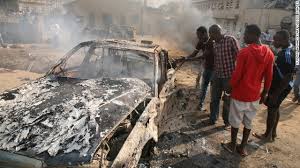
auto calcinataIl ministro degli esteri tedesco, Frank-Walter Steinmaeier, in visita ufficiale ad Abuja, capitale della Nigeria, ha rilasciato una breve dichiarazione: “Siamo in contatto con i dirigenti della Julius Berger International. Il presidente nigeriano Goodluck Jonathan ha garantito la piena collaborazione deile autorità competenti del suo Paese per risolvere il caso”. Questa volta i Boko Haram non c’entrano, ma nel colosso dell’Africa succede di tutto. Anche questo. La violenza è di casa qui.

Verso la metà di ottobre le prime pagine dei giornali e i titoli dei TG di tutto il mondo hanno esultato per la notizia di un probabile accordo tra i terribili Boko Haram e il governo nigeriano. “Sta per essere firmato il cessate il fuoco, fine della belligeranza”. Notizia confermata anche dal governo del Ciad, che ha ospitato il 14 e il 30 settembre nella capitale Ndjamena i negoziati, in presenza del ministro degli esteri  ciadiano Moussa Faki Mahamat . Il governo nigeriano era rappresentato dal direttore del gabinetto del presidente Goodluck Jonathan, mentre per i Boko Haram erano presenti gli sceicchi Goni Hassane e Boukar Umarou.

Mahamat ha precisato ai reporter di RF1: “L’accordo prevede l’annuncio del cessate il fuoco da parte dei Boko Haram, la stessa dichiarazione sarà fatta dal governo nigeriano subito dopo.  La setta si è impegnata a liberare immediatamente gli ostaggi cinesi e quelli camerunensi (sono stati rilasciati i primi di ottobre, ma pare dietro pagamento di un consistente riscatto ).

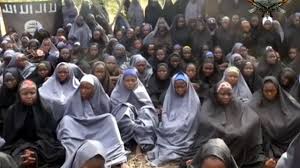
Dopo la dichiarazione da entrambe le parti, cioè Boko Haram e governo nigeriano, del cessate il fuoco, saranno rilasciate le ragazze rapite a Chibok il 15 aprile scorso, mentre la controparte libererà un certo numero di militanti che ora sono trattenuti nelle prigioni della ex-colonia britannica”.

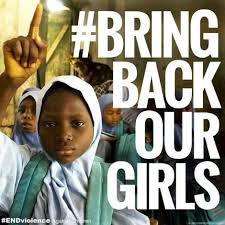
#bringbackourgirlNiente di tutto ciò si è avverato, anzi, una decina di giorni fa i terroristi hanno rapito altre ragazze e giovani donne e tagliato la gola a quattro uomini in due attacchi distinti. Il primo a Wagge, che dista pochi chilometri da Chibok. “Uomini armati in sella a motociclette sono entrati nel villaggio e hanno perquisito casa per casa in cerca di donne. Nelle case dove hanno portato via una donna, hanno lasciato bene in vista 1500 Naira e qualche noce di cola*. Quaranta donne risultano rapite”, ha riferito Lazarus Baushe, un anziano di Wagge, ai reporter dell’Agenzia France Presse (AFP).

Altri testimoni oculari hanno riportato all’agenzia francese che solo qualche giorno dopo sono state rapite 20 ragazze anche  a Gwata, al confine con il Camerun. Stessa scena di Wagge. Entrando nel villaggio, uomini armati hanno sgozzato quattro uomini. Inizialmente le donne rapite erano di più. In un secondo momento sono state rilasciate le più vecchie tra loro. Anche qui hanno lasciato soldi e noci di cola.

scolaresca 1Il 22 ottobre si è verificato un nuovo attacco: questa volta militanti della setta jihadista hanno preso di mira la stazione dei pullman di Azare nello Stao del Bauchi. Un’autobomba ha ucciso cinque persone e ferito altre dodici. Il portavoce della polizia di Azare, Mohammed Haruna, ha precisato che la bomba era stata piazzata su una macchina parcheggiata.

Finora Abubakar Shekau, leader dei Boko Haram non ha rivendicato gli ultimi episodi. Un portavoce del governo nigeriano, Mike Omeri, in un incontro con i giornalisti ha commentato le violenze degli ultimi giorni: “Non è detto che siano stati i militanti della setta. Potrebbe trattarsi di delinquenti qualsiasi. I colloqui di pace riprenderanno quanto prima nel Ciad”.

In Nigeria sono pochi a credere che le ragazze saranno mai rilasciate, che i cosiddetti colloqui di pace possano fermare i feroci terroristi.

Cornelia I. Toelgyes
corneliacit@hotmail.it
twitter: @cotoelgyes

*noce di cola: ha un gusto molto amaro per l’alto contenuto di metilxantine (tra cui la caffeina). E’ molto usata nella cultura dell’Africa occidentale. Si mastica da soli o in gruppo. Si consuma durante i riti o/e le cerimonie o per dare il benvenuto agli ospiti in segno di amicizia o per siglare un accordo o per la riconciliazione tra due parti.

Morto il presidente dello Zambia lo sostituisce ad interim un bianco

0

Nostro Servizio Particolare
Cornelia I. Toelgyes
Quartu Sant’Elena, 29 ottobre 2014

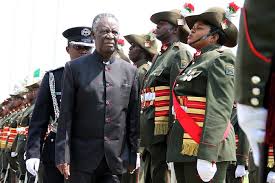
Michael  Sata, presidente dello Zambia, è morto la notte scorsa nella clinica privata  Edward VII di Londra, all’età di settantasette anni.  Sua moglie e il loro figlio erano accanto a lui. Il suo decesso è avvenuto a pochi giorni dal cinquantesimo anniversario dell’indipendenza del suo Paese.

SataEra soprannominato “King Cobra” per la sua lingua velenosa. Era un grande lavoratore. Durante il periodo coloniale ha lavorato come ferroviere poliziotto.

Sata entra in politica nei primi anni Ottanta. Uomo d’azione viene ben presto conosciuto come il politico che non si ferma mai. Era rimasto l’uomo di sempre: un gran lavoratore con una lingua assai appuntita e cattolico osservante. I suoi critici l’hanno accusato di essere un po’ troppo autoritario.  Dal suo ingresso in politica ci mette poco a salire ai vertici dello Zambia e nel 2011 viene eletto presidente, sconfiggendo  il suo rivale Rupiah Banda, il cui partito deteneva il potere da oltre un ventennio.

All’inizio della sua presidenza Sata ha cercato di combattere la corruzione, di creare nuovo posti di lavoro, benessere per la sua gente. Purtroppo le sue ottime intenzioni sono state frenate dall’opposizione e dalla crisi economica.

Durante la sua assenza per la malattia che l’ha ucciso, il Paese è stato affidato al ministro della difesa, Edgar Lungu e non al suo vice, Guy Scott, di origini scozzesi.

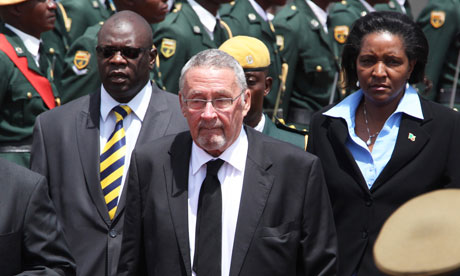
Poche ore fa, Guy Scott ha prestato giuramento come presidente ad interim, “il primo leader bianco in Africa dopo vent’anni”, riportano i giornali di tutto il mondo. Mentre Scott ribadisce: “Sono il primo leader africano bianco democratico”. Resterà in carica per novanta giorni, il tempo di indire nuove elezioni.

Zambian deputy President Guy Scott in Harare, ZimbabweScott è nato nello Zambia, ha settant’anni. E’ un economista, laureato a Cambridge ed è stato vice-presidente fino a poche ore fa. Dice di essere fiero di questo nuovo incarico. E aggiunge: “Forse è uno shock per l’intero sistema politico, ma sono felice di assumere questa responsabilità”.

Alla domanda perché sia stato proprio lui ad essere stato scelto come presidente ad interim, Scott ha risposto: “Semplicemente per la mia lunga esperienza nel seno del partito”.

Scott non potrà essere eletto presidente. Una clausola della Costituzione dello Zambia lo impedisce: per diventarlo, anche i genitori devono essere nati nel Paese. I suoi sono nati in Scozia. Eppure, Scott si sente un africano. Bianco.

Cornelia I. Toelgyes
corneliacit@hotmail.it
twitter @cotoelgyes